
You can read part one of laying a floating floor HERE. It shows how we stripped the carpet and installed the underlayment. Today, I’m going to talk through how we installed the actual floor. As I said in part one, we’re not professionals at this, so this isn’t meant to be a comprehensive tutorial, but more of a testimony of our experience.

I was a very good blogger and took lots of pictures as we ripped out the carpet and installed the underlayment and then I got tired and the sun set (so my natural lighting went away) and I just wanted to finish, so this was the last picture I took. When we lay the floors in the bedroom, I’ll take more.
As I said in part one, laying the floor was the easiest part of the project. Since it is a floating floor, there is no gluing, nailing or sticking…just locking each piece into place. We have nailed and glued floors before and this is definitely my favorite method of installation. That’s a big bonus for the interlocking floating floor. You will still need a table saw and a chop (mitre) saw. You can probably get away with a pull saw instead of the chop saw and a circular saw (along with clamps and a straight edge), but it will make your life easier and the job go faster if you have the proper tools.

The most important piece you’re going to put down is the first one. This should be in the most visible starting place in the room. In our case, it was the threshold that connects the family room to the kitchen. The reason for this is that your room (or my room) might not be perfectly square. Even if the floor is perfectly square where you started, it might end up looking crooked when you get to the other side of the room. If there is a crooked edge, you want it to be as hidden as possible. The first piece needs to be square, straight and firmly in place, since all of the other boards will go off of that one. If it’s crooked, your floor will be crooked, which will look especially bad if it runs the length of a room. I can’t stress enough to take your time with this piece and get it right. Once it’s in the right place, tack it down with a couple of nails to hold it in place. We hid our nails under the lip of the threshold (which we haven’t installed yet.)
Another thing to keep in mind is that you need to leave about 1/4″ perimeter around the entire floor. Wood expands and contracts as the humidity changes and you want to give it some space to do that. You can cover this gap with baseboards and/or shoe molding (quarter round.)
Once that first piece is installed, you can start clicking the floor into place…
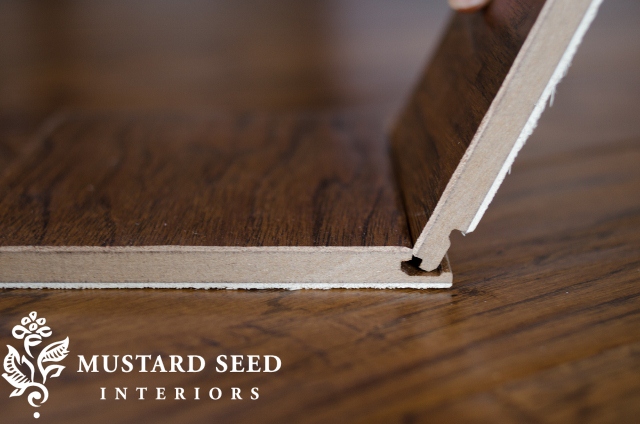

You can see the layers of the engineered hardwood floor. Hickory on top, MDF in the middle and thin plywood on the bottom.
Here are some other tips…
- Have your chop saw in a place that’s easy to access. You don’t want to have to run to the basement every time you need to make a cut. (Well maybe you do, but I didn’t!)
- Save the waste you cut off of boards at the end of the one side of the room and use it to start the next row. This will give you irregular lengths to start your regular sized boards off of, staggering the joints.
- Lay the floors how you read. Top to bottom, left to right (as you’ll looking at the board, not the room.)
- Stagger the joints. It makes the floor stronger and it looks better when they are staggered. The pattern should be intentionally random. I know that’s an oxymoron, but if it’s totally random, you might have seams line up.
- Know that some areas are going to be time consuming. The area around our bar took forever, because we had to rip (cut lengthwise) the boards and make some angled cuts around the peninsula. Don’t get frustrated when you’re stuck on a section. Once you hit open flooring, you’ll fly.
- Use a scrap piece of flooring or wood and a hammer to tap the boards tightly into place. Don’t ever hit the floor directly or you could accidentally mar the finish or dent the wood.
- The nice thing about a floating floor is it’s very forgiving. If you mess something up, you can pull up the boards and redo it. It should be a low-stress project and this type of flooring is a good option for a beginning DIYer.
I hope that helps!
You can see the full room reveal HERE
.

Right now, I’m in my hotel in Houston! I’m getting a bit of rest before a milk paint demo and book signing tonight at Altar’d. Can’t wait!















12 Responses
I did my entire downstairs last year and am so happy with it..
I’ll admit I started out doing it myself and there was
a spot in the floor that was not even and I fought with
it for two days, gave in and hired a guy to finish.
Happy to say, “It looks wonderful”..
Good Post
Sandy
I have a question…What happens if you spill a glass of water? Some of it has to seep down in the cracks right? And does that cause the wood to bubble up, if the MDF bubbles does the wood contain it so it doesn’t show? I’m trying to decide whether to go with install, sand, stain and seal hardwood as opposed to the engineered hardwood that you have.
Thanks!
Regarding MDF, will the shape of engineered wood flooring change over time? The reason why I brought up is that my home has MDF baseboards , my puppy chewed the part of the baseboard. I noticed when the shape of MDF changed after being soaked and pressed too hard. I am still deciding what kind of flooring and I have been looking at hardwood floors, engineered wood floors, vinyl plank flooring. Your flooring looks so great!
I live in Australia and laid vinyl planks just over a year ago, I love them!. they look like wood and the great thing is you don’t have to remove the skirting boards, they butt straight up to them. And if one is damaged it can be removed and a new on glued down.
I’ve been considering floating floors and after your posts, I’m pretty confident that we can do it ourselves. My only reservation is if they will sound hollow or if they feel like laminate flooring. I tend to overthink things though…ugh!!
We put down a floating floor two years ago ~ I’m not in love with it. It’s a little squeaky in some spots. Do you know of any solutions for this?
Love the floors wish I had them!
would love to come to one of your workshops! When are you coming to Tampa?
Thank you for the tutorial! I would love to try this in our home.But we already have some solid hardwood floors and I don’t think I could get a close match with this.But your floors look beautiful!
xx
Anne
I have engineered flooring, and have had for many years. I do love it. Mine is a walnut color…and it is beautiful. However….this, and none of it is good with water…I don’t mean a spill, but our a/c return backed up…just a little, and took out the hall and into the living room. The washer did the same thing…about two feet into the kitchen. It buckled. And had to be replaced. My advice is to buy some extra, and keep it under your bed, so you will have it if they discontinue it. It’s easy to care for …I use the Bona products and mop, couldn’t be happier…
Yours is simply beautiful! Thanks
Enjoy your time in Houston. At least the weather will be somewhat milder than normal for you. 😉
hi Marian … hope your Houston trip is going well. You and your hubby did a great job on installing the floor and it looks beautiful. I want to put wood floor down in our walk-in closet and should have had it done when we did the bedroom. It is glued down. Hope to get one of the grandsons to help but they are busy with college right now. Both of us have knee problems so it would be very hard on us, but we will get it done.
Thanks for all your inspiring blogs.
Audrey Z.
Timeless Treasures
Yours looks great. Can I ask what is the width and color?
I am currently selecting a hardwood for my house. it narrows down to three options. All are gunstock color
1. 3 1/4 inches width(Plank), High Gloss
2. 3 1/4 inches width, Medium Gloss
3. 4 inches width, High Gloss
Unfortunately, there is no 4 inches with Medium Gloss. What would you sugget?