Our furniture get together is going to be a little different tonight. Instead of featuring some of my favorites from last week’s link party, I’m pleased to bring you a tutorial on caning furniture. Caned pieces are a staple in French decor and it always catches my eye, but what do you do when the cane is damaged? Suesan aka the Frou-Fru-Gal will walk us through this process. I can’t wait to try it on my new French daybed (that has two holes in the caning, which are getting larger thanks to my two year old!)
The link party is still down below, as usual, so please scroll down to join in!
I’m so happy to be here on Miss Mustard Seed to show you how to replace Cane Webbing. While many people think this is a daunting task, it’s actually a pretty easy process. I think you’ll be thrilled with the results.
A few months ago I snagged these chairs off of Craigslist for $20!
The owner accidentally put a hole in the cane webbing while moving them, which made for the great deal.
Replacing sheet cane webbing, also called caning, is not hard, but there’s a lot of information to share with you to help you in this process.
In this post, I will show you how to remove the cane webbing and install new webbing.
On my blog,
frou-fruGal, I share more details about how to determine what type of webbing you have, and how to purchase the cane webbing material and supplies. If you plan to give this a try, be sure to bookmark both tutorials.
Removing the Webbing
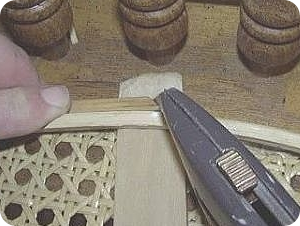
The first step is to remove the old webbing. Start by removing the spline. Carefully, insert the tip of a utility knife between the spline and the frame. The spline is glued in, so you’re trying to cut through the glue join and loosen up the spline.
If you want, you can spray a mixture of vinegar and water onto the spline to help loosen the glue. For my chair, I sprayed some on, but felt like I didn’t really need it. Once I got the knife into the space as shown above, I was able to pry up the end of the spline.
After you have a hold of the end of the spline, just keep prying and lifting to pull it out.
The tool I’m using above is an awl. It has a sharp point on the end and I was able to slide it down the groove behind the spline, while pulling the spline out with the other hand. It came out pretty easily. I used this particular tool based solely on the fact that it fit in the groove.
Not all chairs will come apart as easily. A hair dryer can help loosen the glue, too, but it will also burn the cane a bit. You might need to use the utility knife to cut out the spline. Be careful to keep the frame intact. Try to not chip off any wood in the groove.
Once the spline is removed all the way around, pull out the webbing.
The webbing is glued in, but you should be able to pull it right out. Try to keep the old webbing in one piece as much as possible to help measure the new webbing, especially if your opening is an awkward shape.
Once you have all the webbing removed, clean any remaining bits and pieces of cane out of the groove.
If you plan to stain or leave the cane natural, now is the time to paint or refinish the chair frame.
Purchase New Cane Webbing
You will need to measure the area to be filled or measure the old webbing to determine the size of the new cane webbing. You will also need to measure the width of the groove to determine the size of the spline you’ll need.
Installing the Cane Webbing
Once you have your cane supplies, be sure to measure it against the opening to make sure you have the right size. It never hurts to double-check. Don’t ask me how I know this. I don’t want to talk about it.
Once you’re ready, fill up your bathtub with enough warm water to cover your webbing. Let it soak for about an hour to help the cane become pliable. Do not become alarmed if some of the cane turns a greenish color. This is normal and it will go back to a natural color once it dries again.
While the webbing is soaking, you can gather your additional supplies. You will need some wedges, or shims cut to fit into the groove. You’ll also need some wood glue, the reed spline, a utility knife with a sharp blade and a chisel.
If your piece of furniture has corners like mine does, you’ll want to make a mitered cut for the corner pieces to fit together. Cut your reed spline to fit the groove.
If your caned area is circular, you want to cut enough reed for the entire circumference, plus a little extra for the overlap. I’ll explain how to do the overlap in a minute.
A utility knife with a new blade will cut the reed with some firm, downward pressure. You do not need to saw it back and forth. Just press down on the knife to make the cut.
I overlapped the reeds, trying to cross the reed at a 90-degree angle as much as I could. Then I lined up the knife blade on the diagonal and cut through the reeds. This gave me a nice, mitered corner.
Once your webbing has soaked for a while, you need to remove the excess water. Let it drip for a few minutes, or, if you have a tub like mine that apparently doesn’t hold water for very long, when you come back an hour later all the water will be gone and your webbing will be ready to use.
I love how my bathtub anticipated my needs!
I put the chair on it’s back to make it easier to work with.
Line up the webbing over the opening.
DO NOT cut out the webbing before fitting it in.
It’s better to work with plenty of extra webbing because you may need to adjust the webbing as you go along.
I used the completed chair as a guide to see how the lines of the webbing matched up against the frame of the chair.
The shape of this chair made lining up the material a little difficult. There were no right angles on the frame to use as a guide for the webbing.
If you’re working with a circular area, you’ll need to eyeball how the webbing lines up with the back and front of the chair.
Find a straight line on the frame of the chair to use as a guide.
Once the webbing is in position, using one of the wedges or shims, push the webbing into the groove.
Be gentle at first. You don’t want to break the fibers of the cane.
You don’t need to shove it all the way to the bottom of the groove at first. Just try to work it into the groove and then come back around to get a tighter fit.
When you upholster, you attach one side and then do the opposite sides to get a tight fit. In webbing, I find it easier to start at one point and work in a clockwise fashion around the area.
You want the webbing to be flush against the frame. See how it lays flat against the frame in the picture above?
I had to pull this section out, below, to get it tighter.
Because of the curve of the back of the chair, it was important to get the webbing tight against the frame. If the webbing is tight against the frame, it will form the correct shape along the back. I really had to use the finished chair as a gauge.
As you get the webbing in tighter, you can leave some of the wedges in place to help hold it. You may not get it in as tight as you’d like the first time around.
The webbing does tighten as it dries, but it should be snug
against the wood frame all the way around, before it dries.
Once the webbing is in tightly, cut off the excess.
DO NOT use the utility knife to cut the webbing. It will be too easy to pull it back out.
Using a chisel, gently tap against the webbing to cut it. You want to cut the webbing below where the spline will go. If you don’t, you’ll have little ends of webbing sticking out above the spline.
My webbing was getting pretty dry by this point because I had to keep taking work breaks (I work from home).
I could cut the webbing by wiggling the chisel from side to side and putting some pressure on it, but it was easier to give the chisel a few taps from the hammer.
After you’ve cut off the excess webbing, squeeze a bead of wood glue into the groove and insert the spline.
Firmly push the spline in with your fingers, then come back with the back of the chisel to push the spline down further into the groove.
If you are working with a circular area, you want to begin and end the spline toward the back where the join won’t be as noticeable.
When inserting the spline on a circular area, leave the beginning and end of the spline out of the groove for a couple of inches.
Once the spline is in all the way around, overlap the two ends of the spline, put a shim underneath the spline and cut the two pieces at the same time. This will give you a tight join on the spline.
Push the spline into the groove after the cut. If you didn’t get your spline joins as close as you’d like, you can fill the gaps with a little wood putty.
Wipe off the excess glue and allow the chair to dry for 24 hours before painting, staining or sealing.
That’s it! I really believe that replacing the cane webbing is an easy process. It took me about 30 minutes
to remove the back, and maybe another 2 hours to install the new webbing, and that includes the hour of prep time while the cane webbing was soaking.
Thank you, Miss Mustard Seed for hosting this tutorial.
Feel free to come on over to
frou-fruGal to see the final reveal on the chairs.
Suesan
Thanks so much, Suesan, for sharing your knowledge with us! I know I’m going to be coming back to this tutorial frequently and I will no longer be afraid to buy a caned piece with a hole punched through it!
Here are the rules for this get together…
1.) Your post has to be about furniture. Please, please, please…just furniture. If you find your link has been deleted, it’s not because I’m mean, it’s because your post was not about furniture. You can share makeovers, awesome finds, favorite pieces, furniture arrangements, or even pieces on your wish list! Built-in furniture like kitchen cabinets and bathroom vanities qualify as furniture.
2.) Post a permalink (the link to the post), not the link to your blog.
3.) Both link parties close Friday at midnight PST and I will choose my favorite(s) and feature their piece on next week’s FFF.




















25 Responses
Great tutorial! Thanks for hosting! ~ Lindy
What a great tutorial! You make it look somewhat easy, I always thought this looked difficult to do. I love the look of cane, and now if I see a chair that looks in rough shape, I may grab it and try this. Thank you:)
Fabulous tutorial on replacing caning, sooooo glad you posted this because now I have a great link when I get this question! Thanks as always for hosting Miss Mustard Seed! Finally got around to another piece of furniture, so happy to link up!
xo and happy weekend,
Kate
LOOve love that chair! Thanks for the tutorial and thanks for hosting!!
Thanks for sharing this great tutorial! I love caned furniture and I am happy to know that broken caning can easily be replaced. I love the shape of those chairs, by the way.
Amanda
"that has two holes in the caning, which are getting larger thanks to my two year old!"
gee- im shocked by this. I cant IMAGINE a 2 year old doing something like that 😉 HA!
Suesan and Marian: you ladies are so incredibly generous with your tutorials! I love caned furniture and have been fortunate to find intact pieces thus far, but now I know what to do with the damaged stuff. Many thanks! 🙂
I've always shied away from caning for the same reason you mentioned…a big hole punched through it. Great tutorial, Suesan! Loving the projects linked up. When I finish my hutch, I'll be back to link up…still needs an interior coat & waxing. Thanks again for introducing me to chalk paint & Hannant's!
Wonderful tutorial, Suesan! Really easy to follow along.
I love walking away a little more informed. 🙂
Donna
Wow! The canning process is pretty awesome when shared by Suesan!!! Great job!!
Thanks so much
Hugs
SueAnn
i need to come back and check this tutorial out when i have more time. i have always wanted to cane… was even going to take a class on it… but if i can learn from you… i am all over it! ; )
Great post, and perfect timing! I just got a few can chairs and bookmarking this post should I ever need to replace the cane!! Janell
I have tagged this cane tutorial, as I have spent lots of money on pieces that were cheap but had a hole 'punched' in it! thanks! I linked up a 'vintage' mechanics light that I made…understand if you delete, but I saw a chandelier a few links before! Hope it qualifies!! Have a great Easter!
Thank you Marian for letting me guest today! I'm glad you all like the chair style. My husband does not like them and is encouraging me to sell them.
Thanks for sharing the cane tutorial…I have avoided buying chairs with cane damage. Now I can scoop up a deal or two. Thanks!
Finally I have something today.
I love this party, everybody has such amazing stuff.
I wish knew replacing the cane was so easy…..I gave 6 chairs to friend because they were all broken. She gave them to her Grandfather who fixed them……I wanted them back then……
Here I thought you had to have some huge degree to cane……like was something passed on between fathers and sons……
Great projects & wonderful weekend inspirations! Thanks for hosting!
😀 Lynda
Wonderful feature … however, I'm scared to think what a chair would look like if I attempted this !! Thanks for hosting and letting me share my painted bookcase, which sits my "coastal" sitting room. *Becca*
http://www.adventuresindecorating1.blogspot.com
This is great! I didn't know how to cane. My grandfather used to do these, as well as the actual weaving ones. He took classes just so he could make chairs and gave one to each of his kids and grandkids. I have a very old rocker he did that I rocked all my babies in when they had an especially hard night of teething or colic. I love the sweetness of knowing Grandpa made that rocker, and now I know how to do this. Thank you.
I cannot tell you how happy I am to have you post this tutorial!!! I have been looking forever for a simple how-to on this exact thing and I just couldn't seem to find what I was looking for. Years ago my husband picked up some really beautiful chairs for real cheap. One of them needs the caning repaired and has been sitting in a corner of my bedroom covered with a throw until I could figure it out. Now I'm ready to give it a go. Thank you!!!
frou-fruGal thank you for the excellent tutorial!
Just catching up. Gosh, that looks like a lot of hard work but SO worth the effort.
Hello Miss Mustard Seed, I don’t want to bother you so please disregard this comment if you so desire. I thought of you because I have a set of six cane back dining chairs, two are arm chairs, four are side chairs. They are in great condition except one has a small damaged spot in the cane. I’m selling them on Craig’s List. I know you are PA and I’m in NC (the Charlotte area), but I thought if you had pickers in my area you might be interested. You do such a lovely job on this style of chairs and I would love for these to have some TLC. If you are at all interested please feel free to click this link to my listing…
http://charlotte.craigslist.org/fuo/2818194504.html
What if I want to replace the cain back webbing and put in spindles. Can I do that? How?