
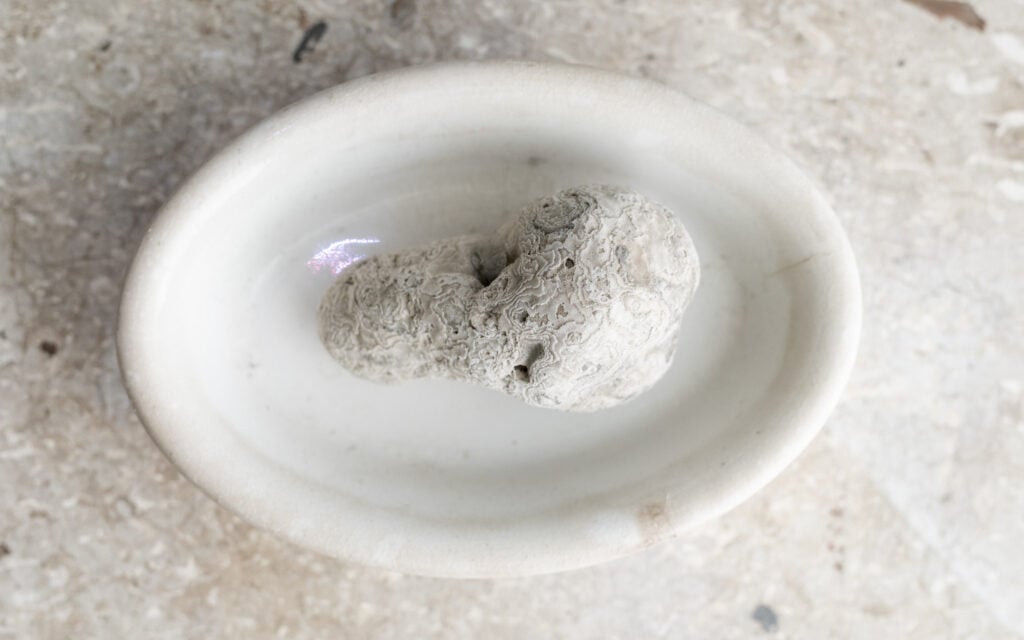
I bet you didn’t see this post coming! I have loved beach combing since I was a child but now I’m getting more into researching what I find, especially unique pieces. While my focus has primarily been on shell hunting, I have also gained an interest in finding fossils and other oddities even if I’m not sure what they are. I’ve learned from years of shopping for antiques that I have a good instinct when it comes to finding interesting things. That same skill seems to apply to beach combing as well. Some of the odd things I collected ended up being ancient fossils and some excellent specimens of bryozoan-encrusted shells. It started with one find that I assumed was a fossilized shell, but the more I studied it, the more baffling it became.

I’m not quite sure why I picked up what looked like an odd rock, but there was something curious about it. It was the shape of a shell but was completely covered in another substance. My best guess was it might be a fossilized shell, covered in years of natural concrete from rolling around in the surf. I asked my Instagram followers and most were just as stumped as I was.
One avid west coast beach comber suggested it was a “concretion” and, after looking it up, I thought she was right. THIS was the article I read to learn more about concretions. While there were some similarities, there were also some differences, so I was going to keep an open mind.

I did jokingly beg people to spare me if it was, indeed, a fossilized turd or some other find that wouldn’t be a prize at all! The funniest thing is that right after I posted that on my Instagram Stories, I handed the unknown object to my dad and asked for his opinion. He started to laugh from his belly and held up the specimen delicately between his thumb and forefinger. “This…is a turd.”
I never seriously thought it was a turd, so I dubbed it the not-a-turd-shell in the beach house to knock down that rumor. We passed around the not-a-turd-shell, examined it, and the majority agreed that it was hallow inside (you could hear water and bits of shell rattling around in there as you would a whelk) and was a shell in some sort of coating. Since it was an interesting shell more than a beautiful one, I didn’t include it in the shell collection contest (although it might’ve pulled more votes my way!) I put the shell in one of my bags to take home and didn’t think about it again until I started to unpack my finds.
I felt a bit like a naturalist, unpacking my discoveries, grouping similar items, and setting aside my favorites as well as the ones I wanted to research. I brought home my biggest shell haul yet (it was sort of like shopping while hungry), so most of them went out to my garden and I kept some of my very favorites to display around the house. Even though I cleaned them pretty well at the beach, I still managed to get sand everywhere! A little bit of South Carolina was sprinkled all over my studio.

I created a group of fossils and other curiosities and was reminded of the not-a-turd-shell. I set it on my desk and took a close-up picture of it with my phone. I had photographed it with my phone at the beach, so I’m not sure why this photograph yielded so much more detail, but it did. What looks like a hard, sandy coating to the naked eye, is actually fine lacework. It almost looks like fabric. It was clearly made by something living, something organic, and not simply layers of compressed sand and water. It was also clearly not a concretion.
As a trigger warning, if you have trypophobia, you’ll hate these next few pictures!

Bizarre, right?? It’s so perfectly woven that I almost wondered if it could be wrapped in something manmade. So, this sent me down a research rabbit hole into fossil forums, beach-combing threads, university websites, and museum journals. After dancing around the general area for a while, I finally hit the nail on the head when I found this on the Wooster Geologists Blog…
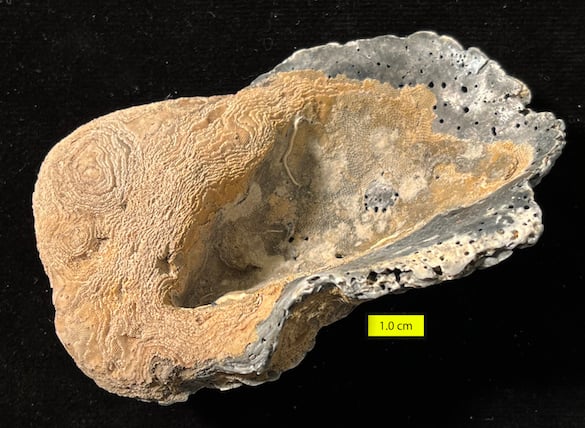
It’s an oyster shell encrusted in the same material as my not-a-turd-shell. (See, I told you it wasn’t a turd!) And then, I found an absolutely magnificent example along with a detailed article on the CU Museum of Natural History site.
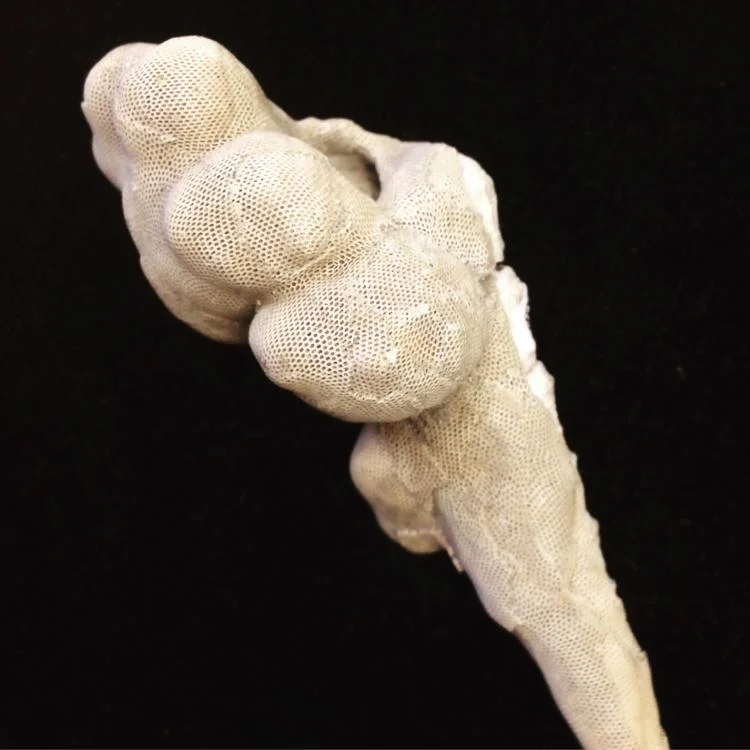
The coating on these shells is bryozoan, a colony of small animals called zooids. Each tiny hole was a “house” for one animal, so there would’ve been thousands living on my one small shell. My particular example has been worn away from the friction of the surf and sand, which is why multiple layers have been exposed. While some bryozoan-encrusted shells can be fossils, they can also be modern. My shell is likely a more modern shell (old, but not millions-of-years old), but still a very interesting example of the way nature was created to reuse and repurpose. An unused whelk shell becomes an entire bryozoan colony.
Now that I knew what the not-a-turd-shell was, I was able to see that I had collected two more examples of bryozoan-encrusted shells…

It was the natural distressing and age that I was attracted to. It is sort of like the ocean’s version of chippy paint! I did include the one above in the shell collection competition, so clearly voters weren’t missing a bryozoan-encrusted shell.
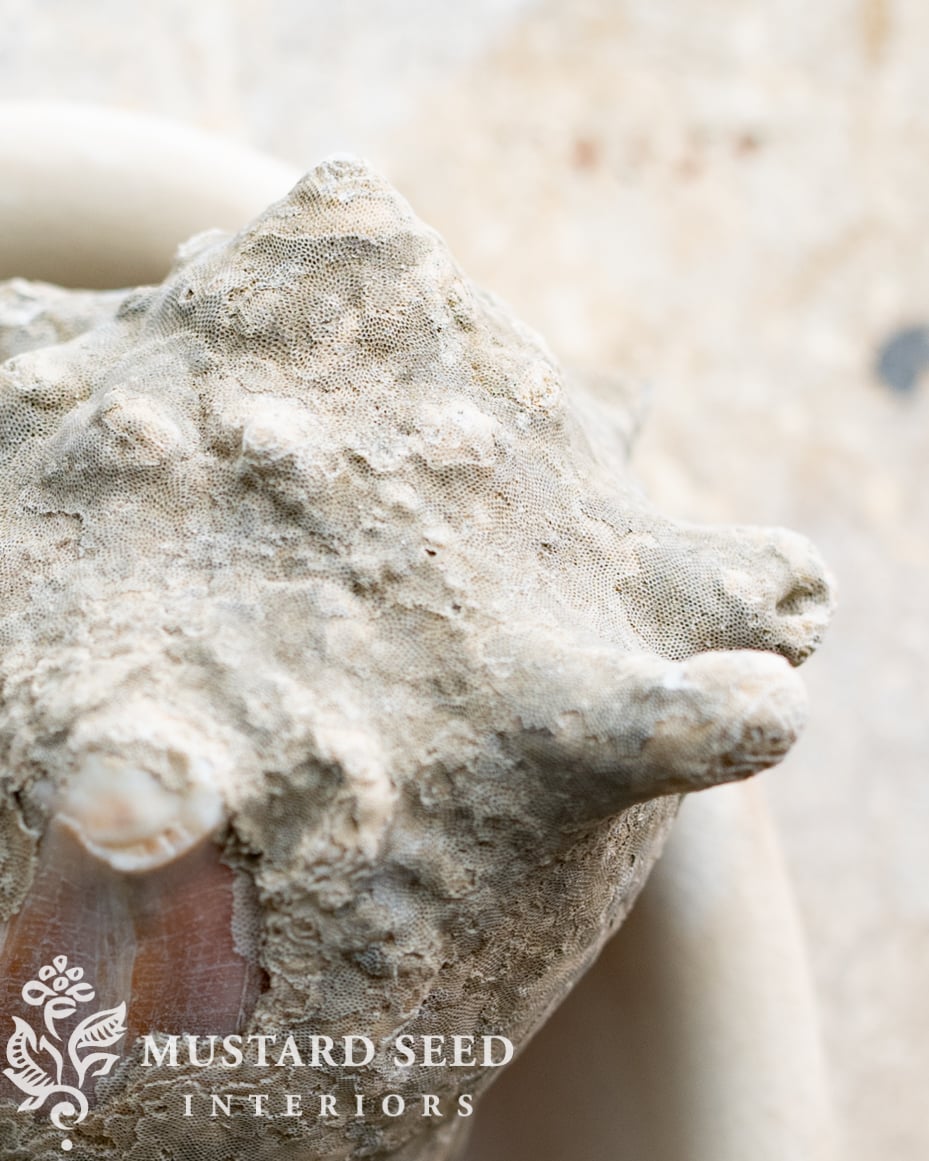

I almost have a series of three that tell the story of how a shell gets encrusted by Bryozoan at various stages. I have been fascinated by it now for two days.
So, there’s your science lesson for today and a little-known fact to amaze your friends at boring parties.







23 Responses
Thanks for the lesson in ocean zoology . Now I will have to go examine my shells. 😊
I love the close up of it, so beautiful
It is beautiful up close. I love your not-a-turd.
I am just so impressed that you found all these shells at IOP’s and I walked on the same beach, the same week and found hardly anything worth keeping or collecting! Obviously, I wasn’t walking in the same area….lol. When I saw the close up of the non-turd shell, it almost looked like petrified cheesecloth on it.
Long time rock/shell hound and recent fossil enthusiast here 😊. I have been interested in 19th century women naturalists including Mary Anning, an incredible fossil hunter from England that hunted on the Jurassic coast in 19th century. Sold these “curiosities” to support family. Remarkable Creatures by Tracy Chevalier is an incredible fictionalized account of here life.
Thanks so much for researching for us!!! They are so cool looking. Kudos to your persistence!!!
Wow Marian! This is so cool, I love the pattern on the shell, it looks like lace!!
I think it looks like lace!!!
So glad you got an answer. My family enjoys collecting rocks, shells, and fossils. We have a few run off streams on our property and always finding bryozoans. The ones we find here resemble bones. Always researching what we find and learning. My husband is from Michigan, and we bring home beautiful specimens whenever we visit. Thank you for sharing and keeping your post topics varied.
I love collecting shells and oddities from the ocean. My mother was also a collector and loved the oddities as well as the pristine and I have all of her collection as well. My husband laughed at me when we moved 3 times in 4 years for lugging the shells with me. I did let some of them go at a garage sale. I was fascinated by what you found out. Thank you for sharing it.
What happened to the previous post about the white shelves? When i click on the link on instagram it says “no results found”
I had some technical glitches with my blog yesterday and it had to be reverted to a backed-up version that was before that post was written, so the post was deleted! I am working on rewriting it.
Darn Mercury Retrograde!! It started April 2.
Darn glitches! Looking forward to the rewrite!
Wow, that is good to know. I have several shells like this in my shell collection from childhood days. I always thought it looked like sheer mesh fabric/gauze.
Wow, that is fascinating. It looks like an intricate lace pattern. Thanks so much for sharing.
I have worked for the past 28 years in a Geography and Geology department at a big state university. My first response was to tell you to contact a Geologist specializing in Paleontology at your local university. The Paleo professor in our department specializes in forams (Foraminifera). She is quite knowledgeable about ocean critters. Glad you figured yours out!
Thanks for sharing your detective work! Such beautiful pieces – like others have said, looks like fabric or cheesecloth. Now I know you like to paint still pieces :). Would love to see a “Marian” version.
I LOVE all you post about but this one goes down as one of my favorites. Thank you for reminding us to be curious of nature and taking the time to educate all of us.
Beautiful and fascinating…thank you Marian.
Amazing shell . . . . . while several people have said they think it looks like lace to me it looks like honeycomb.
That is so cool – thanks for sharing what you found. I love your family’s sense of humor about it, too.
So lacy at natures best.
Thank you for the rest of the story~ it’s fascinating!