
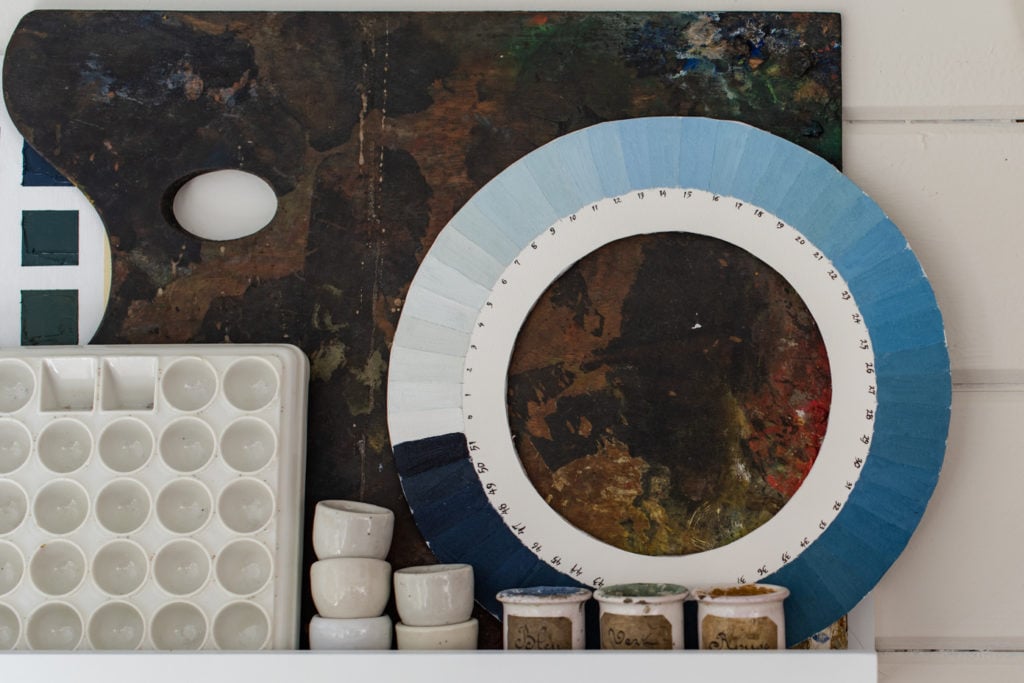
Have you ever heard of a cyanometer? I hadn’t either until I was doing a random search for vintage color wheels and came across one. It’s a device that measures the blueness of the sky! How perfect is that for someone like me who 1.) loves blue, 2.) loves studying color, and 3.) loves painting skies? Pretty darn perfect.

The picture above is the original cyanometer that was invented by Horace-Bénédict de Saussure and Alexander von Humboldt in 1789. It’s a circle with 53 colored sections ranging from light to dark. Isn’t it just beautiful? I feel like it’s a work of art in and of itself.
I looked around online to see if I could find any information about making a cyanometer. What specific blue should be used? Or what colors should be mixed? I didn’t find any tutorials that were helpful. (One used paint chips from a hardware store and one made what was essentially a blue color chart.) I wanted to make one like de Saussure & von Humboldt!
Yes, these are the things I do in my free time.
So, one Saturday morning when the boys were at their climbing practice and Jeff was taking a drive, I pulled out a compass from my antique drafting box and put that pretty thing to use making my own cyanometer.

I drew a circle that was about 11″ wide and then did the math to divide the circle into 53 parts, which took me two tries to get it almost right! My geometry teacher would just nod, knowing that he did the best he could with me.

Instead of making 53 sections, I ended up making 51, but I decided that was close enough. Even 51 shades would be a challenge to capture the subtle shifts in value.

I made the numbers with a Micron fine liner pen so and used writing that looked similar to the original wheel. To me, that was a part of the charm of it!
And, as an aside, I love this triangle ruler. I picked it up with I shopped for antiques with my mom in PA for $2.00! It has a great patina and reminds me of the plastic triangle ruler I had as a kid. I love using beautiful tools that make the creative process that much more enjoyable.

I printed up a version of the original wheel, but I knew it wouldn’t be completely accurate. It was the best I had to work off of, though. I knew immediately that using just one blue wasn’t going to work. I needed to mix colors to shift the color temperature as well – warmer on the lighter side and cooler on the darker side. So, I ended up using Ultramarine Blue, Burnt Sienna, Cadmium Yellow, Indigo, and Titanium White.

I mixed and brushed on each color. I have to say that the process of mixing the colors, check for slight variations, was such a good exercise. And, man, was it therapeutic. If you ever just need to play with paints, make a cyanometer.

Once it was dry, I cut it out…

…and mounted it on a piece of cardboard.

It’s definitely not perfect, but I absolutely love it! When I shared it on Instagram Stories, several people asked if I could make a tutorial showing how to make one, but it’s so random, I wasn’t sure if there would be any interest. Does anyone else want to get into the nitty-gritty of mixing colors to make a cyanometer? (You could use gouache or acrylic if you didn’t want to use oils.)

In addition to enjoying the process of making the cyanometer and loving it as a studio accessory, it is quite a handy tool!

I took the cyanometer outside a few days ago and it worked quite well! I could see how I’ve been painting most of my skies much lighter than a typical blue sky on a sunny day. I would say I paint the sky 15 or lighter. The sky on that particular day was a solid 25-26, although it’s hard to capture how well the wheel matched the sky on camera because of the glare.

I should “take a measurement” with the cyanometer every day just to see what the average is!
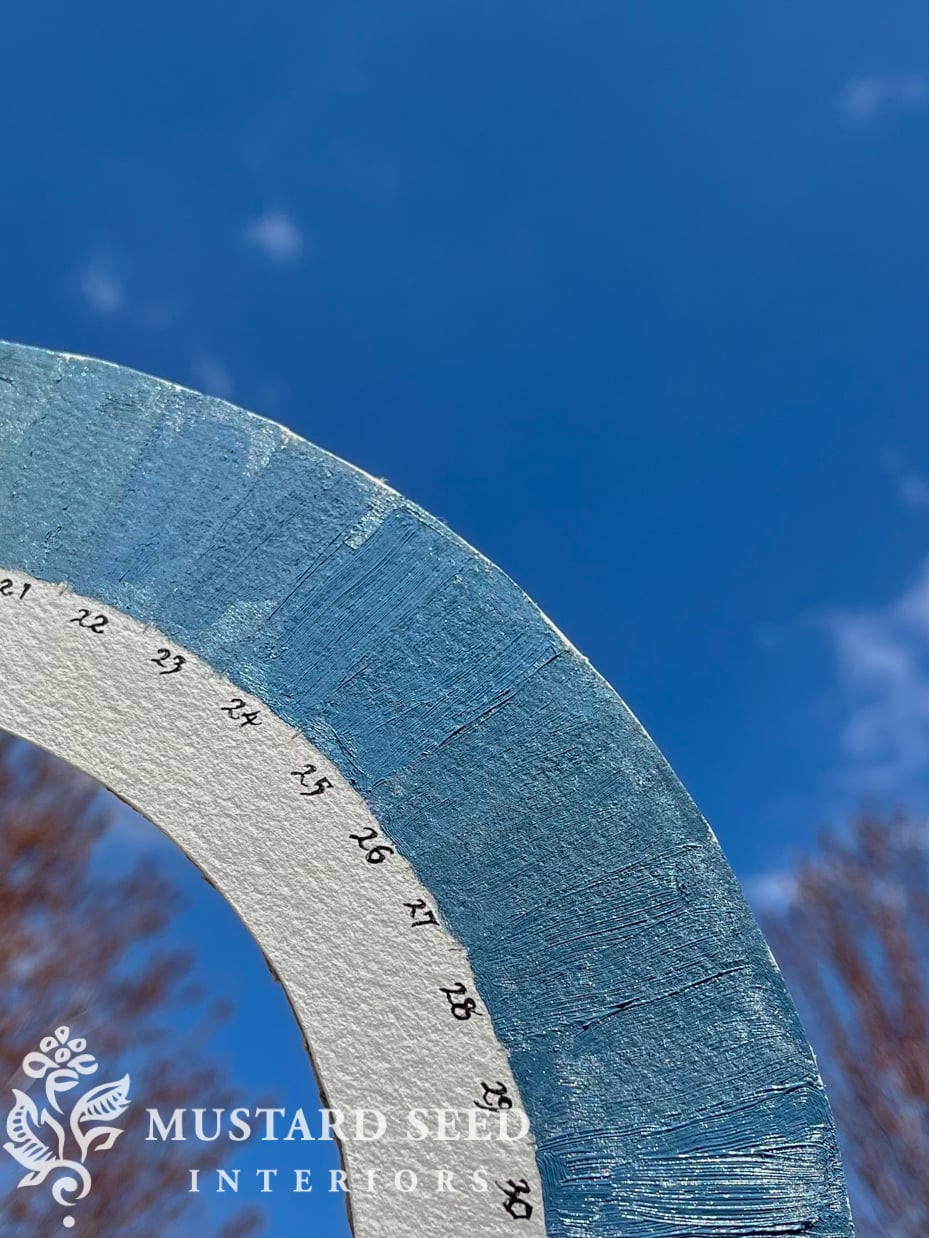
I do plan to take it with me when I paint outside to help with improving my color accuracy (although painting my interpretation of the sky is a part of the fun.)

How will you play creatively this weekend?
If you would like some more ideas for creative play, like sketchbook tours and bottling pigments, you can find more posts on the topic HERE.





20 Responses
I will be painting with my camera – I live in El Dorado Hills where the super bloom is occurring right now, I will be trying to capture the beauty the eye sees which is almost impossible.
Oh, good for you! What a wonderful creative endeavor!
Cyanometer aside, I think the way you capture skies in your paintings is incredible!
I would love to have a tutorial for a cayanometer. In my opinion this may be the best post you have ever done. I studied Alexander Von Humboldt in college, (back in the dark ages) so for a little Von Humboldt trivia, He was the first person to write about human induced climate change.
This is so lovely Marian! I love doing your two color study charts. This is just a whole other level!! Can’t wait to try. Also, would you consider doing a 3 – day in person oil painting workshop? It would be so great to come together with other creatives and paint and learn from each other in a peaceful setting in the country.
I’m excited you released your painting course online! I already signed up and ready to go ?
I have a very similar triangle ruler. Since I’ve had it since the 1960s, I assume it was one my father used. He was an electrical engineer. Mine says it was made in West Germany.
Dear Marian,
I love painting the ski! My husband recently gave me a cyanometer as a “just because” gift, I absolutely love it. It was a purchase from Etsy “CyanotypeHandprinted” it came beautifully packaged. It did inspire me to create other paint mixing studies. I have signed up for The Atelier course and was so excited to purchase the Color Wheel Stencil!
This is awesome and I would definitely make one if you post a tutorial. Looking forward to start the class: The Atelier!
Yes a tutorial would be a fascinating idea!
I think yours came out great….but how do you use it? Did you write down the combinations of colors used to get that exact blue? OR do you just mix the paint until it matches the swatch.
You must be a true artist if you love doing things like this…..Me, I would just want to put paint to canvas!!!….Of course that is why you are selling a lot and I am not!!!! lololo
Would love a tutorial, this is so cool!
Marian, I am not much of a painter, more of a photographer, but I love knowing about the cyanometer. Another word to add to my vocabulary! Thanks for sharing your discovery.
I think you did a great job. Love it
I love that you did this. It is the kind of thing I’d be interested in, so if you give a tutorial that would be FUN!
So do the numbers on the cyanometer correspond to the color mix in that patch? As in, you recorded what colors you mixed to get each numbered color swatch?
No, they are just reference numbers to give each color a “name.” I mixed the ratios by site using colors I regularly use on my palette. I am pretty good and mixing colors by site, so I don’t record recipes.
Yes! I’d love to make one!!!
I am fascinated by this – please share a tutorial! So beautiful!
Marian,
This is amazing. Not only in its function but the design and beauty of it. You are truly so creative. I love watching your projects and all that you do. Thanks for sharing.
xo,
Karen
I would love to learn how to do this and then could do it in any color I wanted. One of my biggest problems painting is mixing colors. I usually end up with mud.