
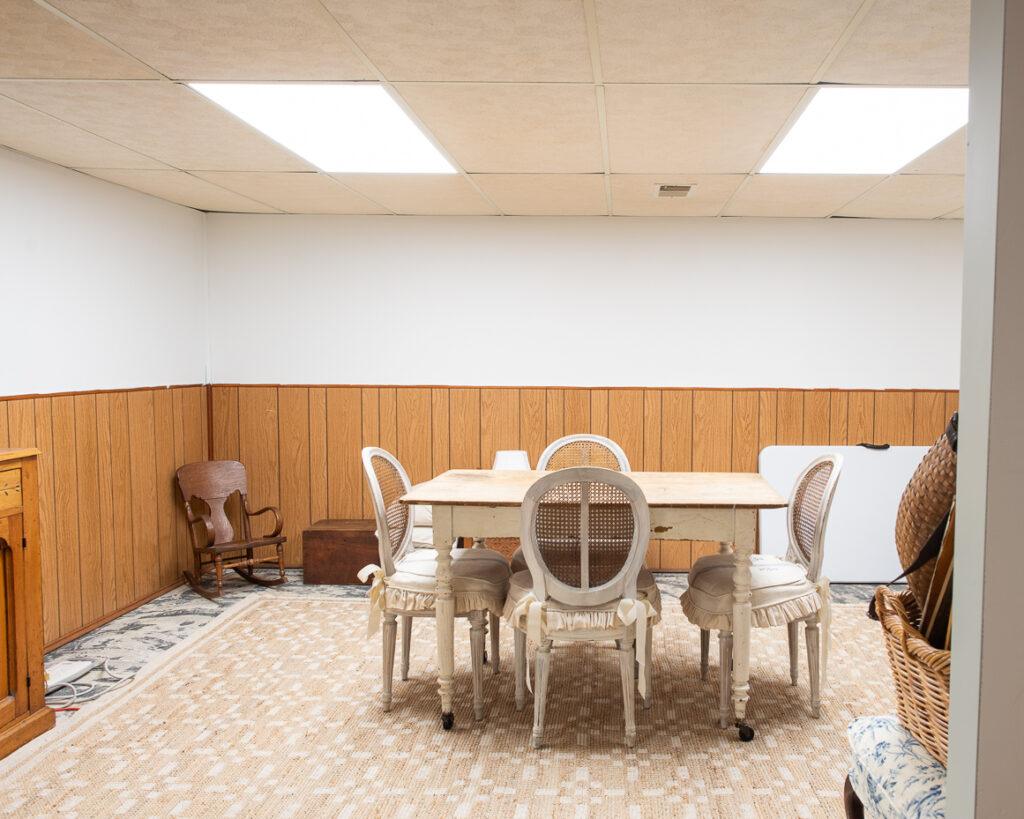
Since it comes up every time I show our basement here, on Instagram, or anywhere on the Internet, let’s discuss the eyesore that is drop ceilings and some of the available options to improve them. Let me first declare that I am anti-drop ceiling. I understand their practicality, affordability, and necessity in some circumstances, but I am still not a fan. And, in my house, I strongly dislike having a drop ceiling. I would say hate, but I don’t think I quite cross that line. I just really, really don’t like them. So, for all of those who point out how ugly the basement ceiling is, I am in full agreement with you. If anyone felt like I needed convincing, I don’t.
If drop ceilings were in the main living areas of the home, they would’ve been ripped out shortly after moving in. In this particular basement, however, there were so many competing eyesores that it was pretty hard to worry too much about a drop ceiling.

Now that other areas are looking better, the ceilings are becoming more of a sore thumb and, again, I see it too. I’m with you!

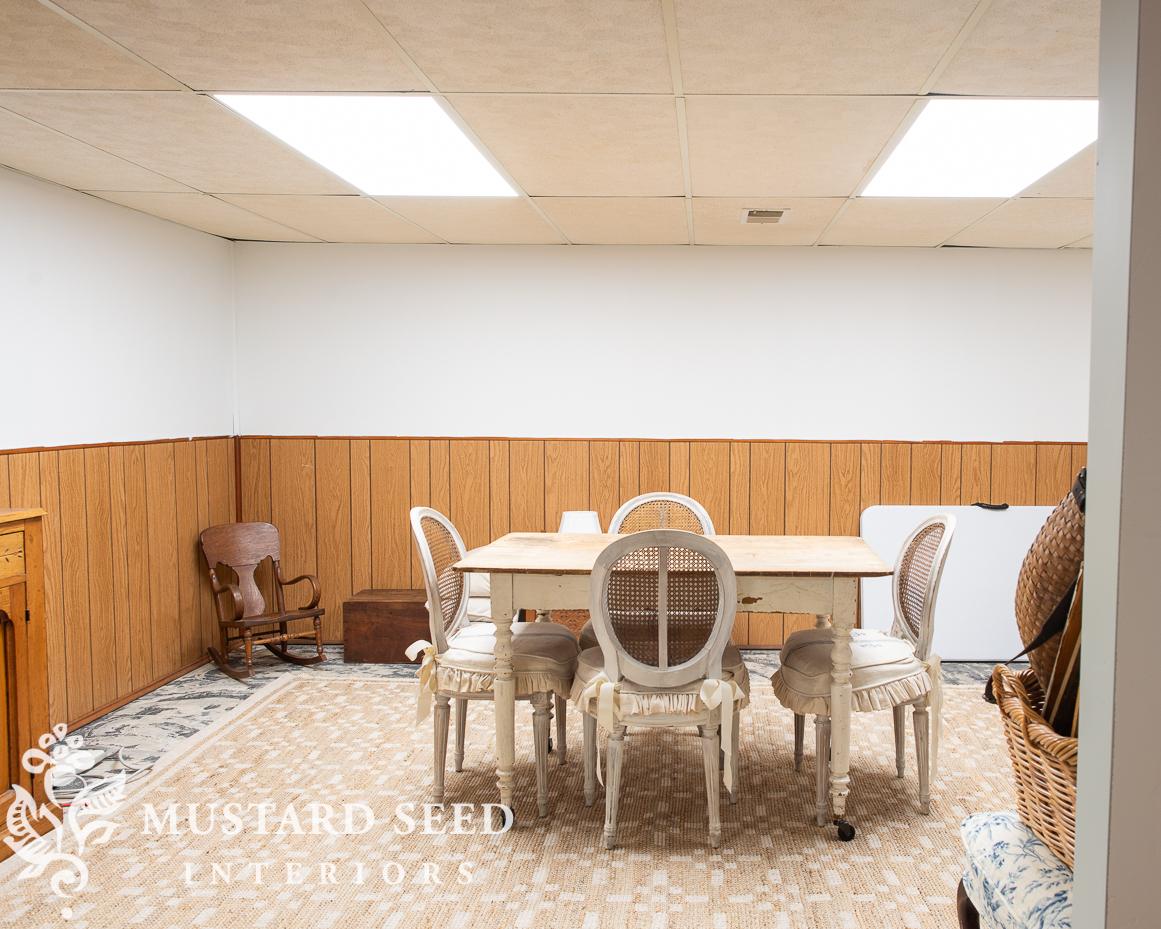
I’ve sprinkled my explanation of why we’re not doing anything to it (for now) throughout a few of the posts on the basement makeover, but I thought I would put it all in one post to refer to later. Our house was built in 1970. It was built in an era when basements were generally used for laundry, a chest freezer, storage, and a place to send the kids to rollerskate when it was raining. It was in the early days of people wanting to have a “bonus room” in their house – a place for kids to hang out, for slumber parties, to have a home gym, and to put a ping-pong table. A lot of homes in our area have basements that were finished or partially finished after the house was built in order to add those bonus spaces.
Our basement was partially finished in a way that doesn’t include any windows. It doesn’t have a bathroom. It has been flooded previously when gutters were clogged or during extreme weather, so that potential is always there. It isn’t a walk-out basement, and the only two exits are into the house and through old-fashioned Bilco doors. Without extensive renovation, this basement is always going to be what it was intended to be – a bonus space. Since the rest of the house meets our needs, we’re good with using the basement as exactly that.
With that being said, let’s talk about some options to improve a drop ceiling, because there are a lot! The lack of action on our part isn’t because I don’t have ideas or haven’t done a bunch of research on the subject. As a huge fan of paint and one who has painted just about every imaginable surface, I first looked into painting the drop ceiling.
I tried to find a good before-and-after picture of a drop ceiling painted white, and I wasn’t able to locate one. I did find several that were painted black, but that’s not the direction I would go. The issue with properly painting a drop ceiling is that you have to account for the fact that there are removable parts. If you paint it all with a roller, as you would a drywall ceiling, you will have issues with tiles sticking to the grid and even peeling paint when trying to remove tiles. It would be easy to paint with a roller, but it would be sloppy and would cause issues in the future. The proper way to paint a drop ceiling is to remove the tiles, prime and paint the grid and the tiles separately, and then put the ceiling back together again.
In my research, I found a tutorial HERE for supporting tiles to paint the grid and tiles without removing them, but this would be pretty time-consuming given the size of our ceiling. It makes it more plausible. We would probably use spacers instead of big braces, though.
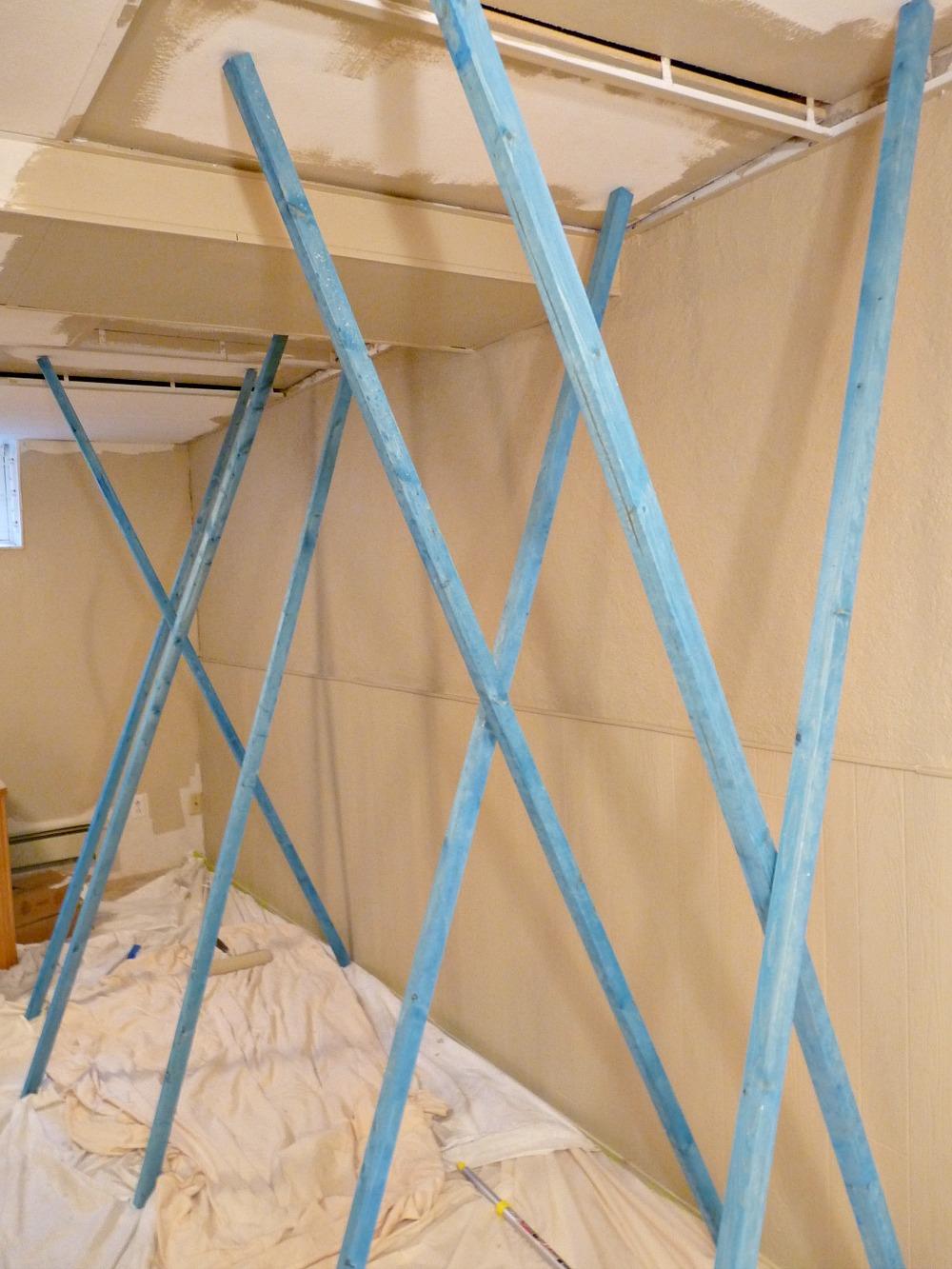
When I think about all of the time and neck craning involved in painting this ceiling, though, I move on to other ideas. I’d probably rather rip it out than paint it, and that, too, is an option. Removing a drop ceiling to expose the floor joists, wiring, and duct work can look pretty good in the right space. HERE is a before and after from Effie Row.
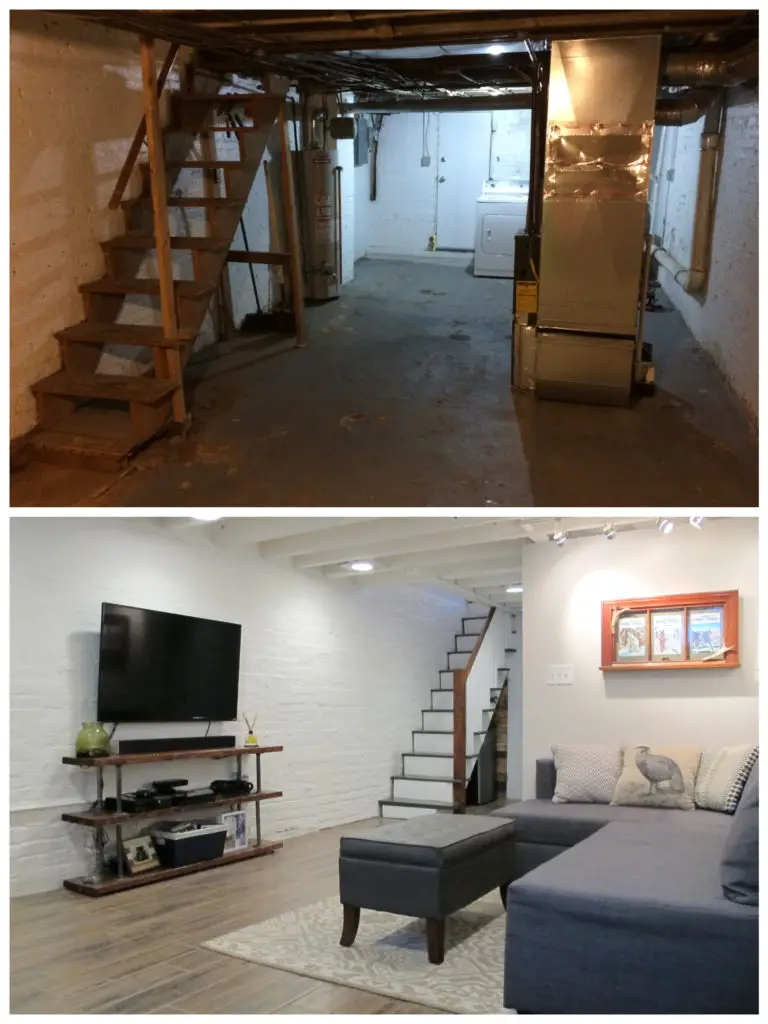
I think it works well in this place because of the character of the house. The painted brickwork and old joists give off an industrial studio vibe. I’m highly skeptical that my 1970s basement would look as successful.
Here is an example of a newer basement finished in the same way…

Is it better than a drop ceiling? I think that’s debatable.
There are also lots of products on the market to camouflage or completely hide an existing drop ceiling. This includes magnetic grid covers and tile replacements that can replicate woodwork, tin tile ceilings, and more. There are even faux planks that can attach to the underside of a drop ceiling grid. HERE is an excellent tutorial by one of my old school blogging friends, Sandra of Sawdust Girl, showing how a wood plank ceiling system works.
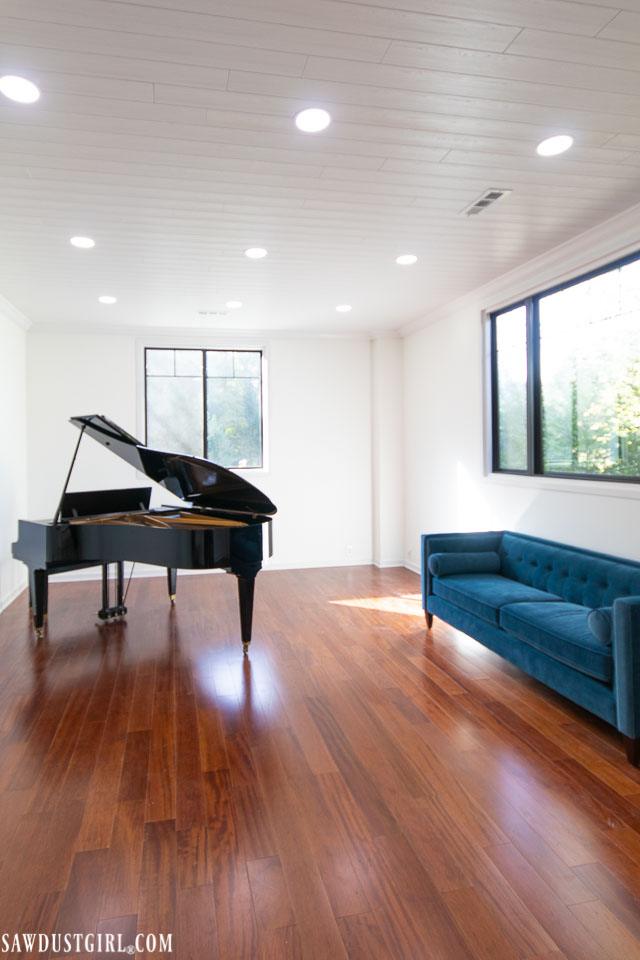
I’ve researched several of these options for our basement drop ceiling, but once I start doing the math, I would rather put that money into having a drywall ceiling installed. Since we use the space as a teen hangout and exercise space, the basement is very low on our priority list. We need to get through new windows, replacing a sunken sidewalk, a 1/2 bath installation, and two bathroom renovations first.
Maybe one day, I’ll have nothing to do and I’ll get a bee in a bonnet about the drop ceiling. That’s always possible. We’re not ruling out doing something to the basement ceiling ever, but with older teenagers who will move out in a few years and a house that is plenty big, it may never be a high priority. As I’ve shared in a few posts about the basement, our goal is to make it better. We want to make it feel clean, bright, updated, and more like a functional bonus space. We want it to feel finished and useable while still keeping it easy to clean up in case of flooding.













17 Responses
Wonder if there’s an easy way to do a “drop fabric” ceiling to hide the tiles?
Do tell, is Marshall headed off to college this fall? As a follower since your guys were preschoolers, I know this will be a big change in your lives!
It’s crazy how old they are now! Marshall has been taking classes at our local community college since his junior year, so he just has one more year to get a degree in Engineering. He’s going to finish that and then move on to finish at a four-year school.
I agree with you. There is so much you have done and want to do, it would not be a priority. I know you are not afraid of hard work, but it is not a ‘beauty space, even though it is pretty amazing now.
You have made the ceilings not as important.
I’d paint it and then either paint the floor or put down some peel and stick tile. It is already looking way better with what you’ve done.
Why worry about a ceiling that does its work? That cover up all underneath it? The boys are no small kids and will leave home in a few years. Will this space be used? If I look at your moving record, you might not even live there in a few years. It will look much better when the walls are painted and the floor is done. You put more than enough energy into something you will never use frequently. As you said, more than enough work on the rest of the house.
The kitchen in our 2 story 1970’s home had a dropped ceiling with a recessed florescent light panel in the center. It was awful and it cast shadows over the counter tops and felt so oppressive. Several years ago, I finally convinced my other half that we needed to take it down! Such an improvement and the bonus was that I ended up with space above the cabinets to display my treasures.
What does it look like under the drop ceiling? Is it unfinished wood with ducts going here and there? Maybe that would be good enough since it is natural. We have an unfinished basement with painted white walls and a wood ceiling and I don’t think the ceiling is awful.
We chose to remove the drop ceiling in our 70’s rancher basement. There had been a mouse issue with the original owners, elderly never went to the basement, etc. We didn’t paint just left it exposed and we like it, it’s a man cave/office for hubby.
In our old 1988 house, we had the drop ceiling in the basement spray painted white. It looked fine for the 15 years we lived there. Agree, we didn’t spend money on the basement.
Oh my gosh! In life, we all have to make some tough choices. Why can’t some people accept the fact is -the decision has been made to spend your money where it makes the most sense?! What you just said is that while a drop ceiling would not be your choice if you were chosing, the choice has been made. You have already made the space into a comfortable, inviting place that serves your many needs and purposes. Yet, some are still obviously not ready to accept your choice. This is a basement bonus living space in your lovely home, after all! Your friends who will be invited to share the space will probably not notice or care what type of ceiling it is. Also, if someday you need access to the many wires, ductwork, water pipes within the space for repairs, it will be a heck of a lot easier and cheaper to do them.
Just take down each tile, they come out so easy and paint a few each week, pop them back in and paint a few more. Do a checkerboard pattern in your favorite colors or just do one color. Have fun with it!! I just painted ceiling tiles today that got wet and stained. They may not be the best ceilings visually but for basements they are a must, to me anyway! Basement looks very nice and clean and like the paint colors!
Not sure why people are still offering suggestions on “fixing” this ceiling? You have a lot of patience, Marian. Lol.
Our basement has a similar drop ceiling. It houses my sewing room/craft room/storage for “extra stuff” like paper towels, garbage bags and my husband’s side has his fishing and gun stuff and an upright freezer and lots of cabinets–not a place that guests often see. However, to make the basement look nicer, my husband replaced the flickering, florescent lights for new LED lights, pulled up the horrible, old carpet and installed a nice wood-look laminate floor and wanted to do something to make the ceiling look better.
He got rolls of teal wallpaper (I think it’s vinyl) and we took down all the ceiling tiles and cut the wallpaper in squares the size of the ceiling tiles and covered each one. It actually looks quite nice as some of the ceiling tiles were water stained or chipped. Now they’re all smooth, teal squares. If you’re interested in having me send you a couple pix of it, you have my email address.
I had to laugh – at myself – when I read about your research into painting ceiling tiles. When we did it, I was desperate to just clean up the ceiling and brighten the room so I painted over everything! I never realized there was a correct way to do it so that the tiles wouldn’t stick to the grid 🙂 Anyway, it was a budget decision we made until such time that we could do drywall or a new drop. It worked for us at the time! Bravo to you for researching and finding out the right way to do it.
I think you are smart to do exactly as you are doing. Just one thing I would point out, one reason you have drop ceilings in the basement is so that all the wiring and plumbing is easy to get to, if needed. I would be cautious about replacing it with dry wall and locking yourself out easy and quick access to those things. I really cannot believe how people are reading this post and still leaving comments on how you can do what you don’t want to do. lol
Such a relatable post! I’ve always struggled with the look of drop ceilings too, especially in older basements. You’ve shared some great ideas and realistic thoughts on prioritizing projects. If anyone’s considering painting for a fresh look, I’d recommend checking out Dulux Paints – they have some great options that could brighten up any basement space!