

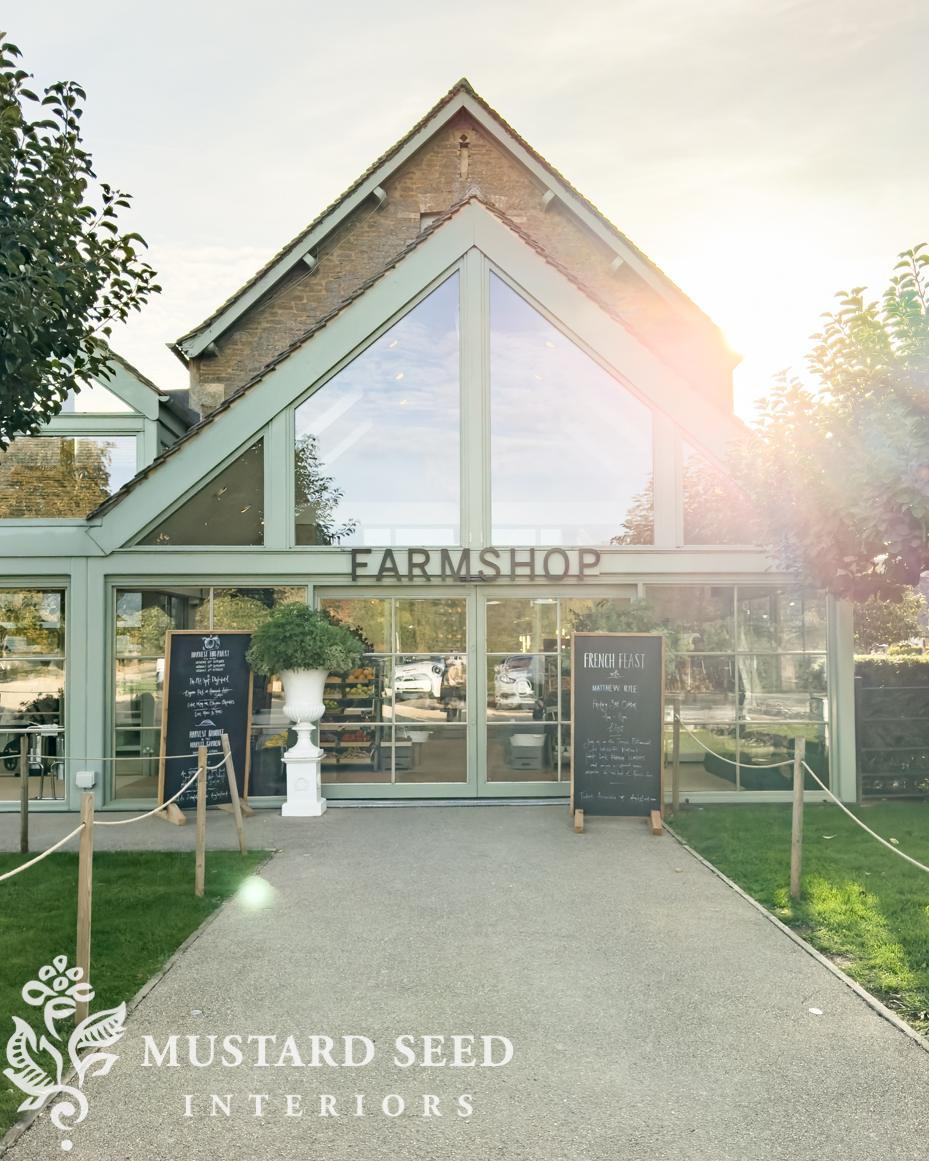
After visiting Cotswold Farm Park and taking my fill of photos of rare breeds—cows, sheep, goats, pigs, and more —we went to meet Julia’s sister-in-law, Carol, at Daylesford Organic Farmshop. Even after spending only three full days in the Cotswolds, I feel confident recommending this shop as a destination to add to your itinerary when in the area. It’s not just a farm shop, but a beautiful store with lots of inspiration and eye candy, local British specialties, a garden center, and several different places to eat (my mom likened it to a high-end food court). Julia thought it would be a nice spot to grab some refreshments and to do a bit of shopping, if we wanted. As much as I enjoy shopping, I found myself disinterested in most of the stores we window-shopped while touring various villages. It’s not that there was a lack of beautiful, enticing things to buy, but I was far more interested in taking pictures and soaking in the architecture, countryside, and history. Other than a courderoy tunic and scarf from Seasalt Cornwall, I didn’t really feel the need to buy things.
But Daylesford is a destination more about the experience than souvenir shopping.
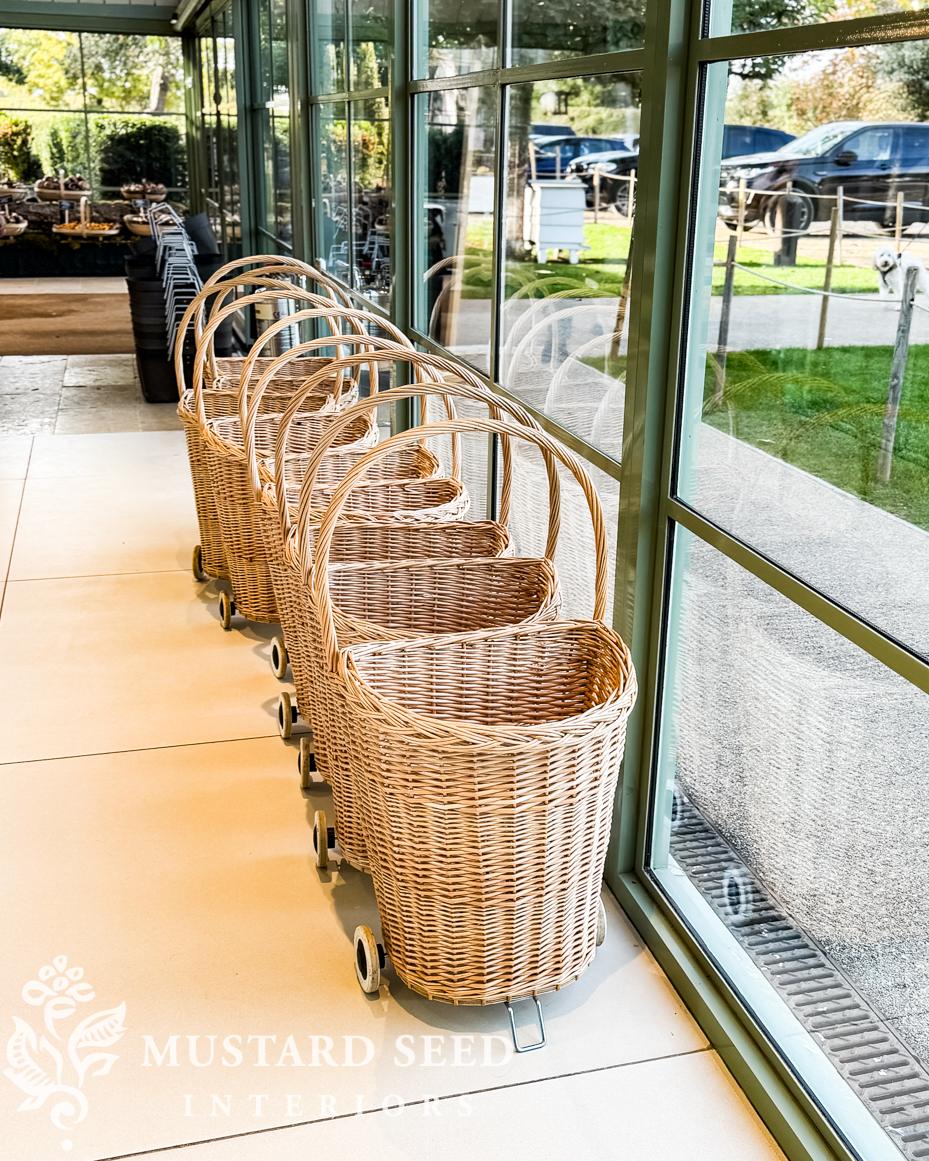
When you walk through the front doors, you’re greeted with charming wicker shopping carts in a row.
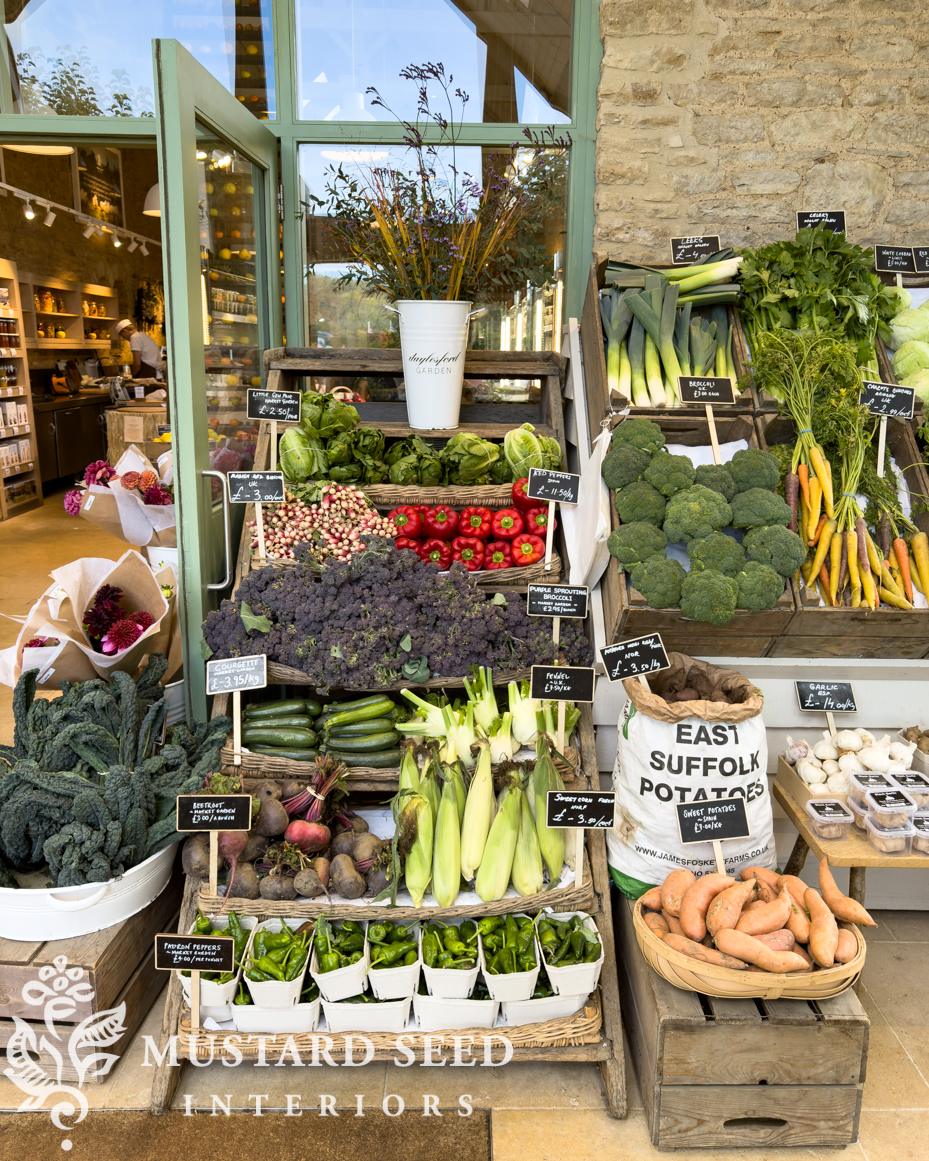
As you would expect from an organic farm shop, there was a wide array of fresh seasonal vegetables and produce.

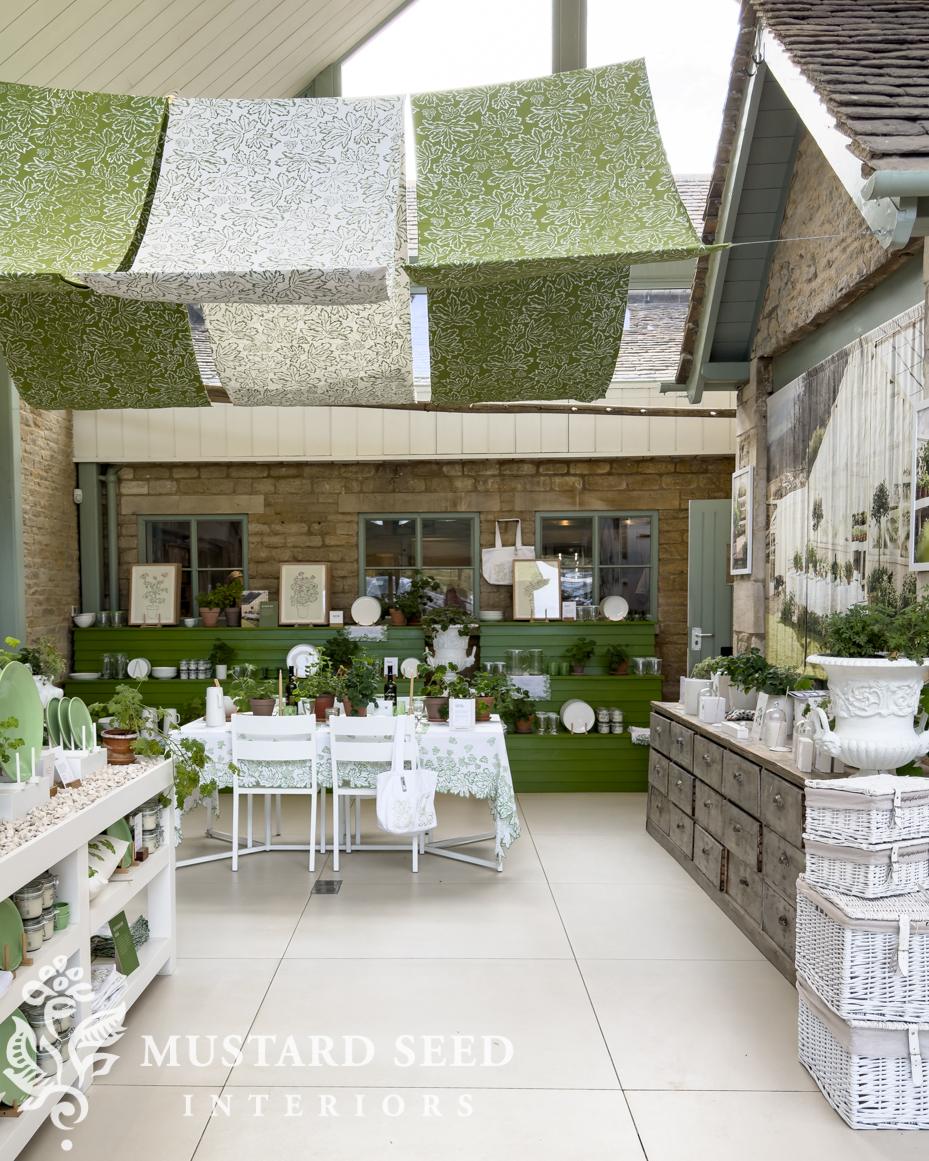
As you made your way through the store’s sections, you were greeted by displays that were visually interesting yet tidy and uncluttered. It was all very chic and appealing.
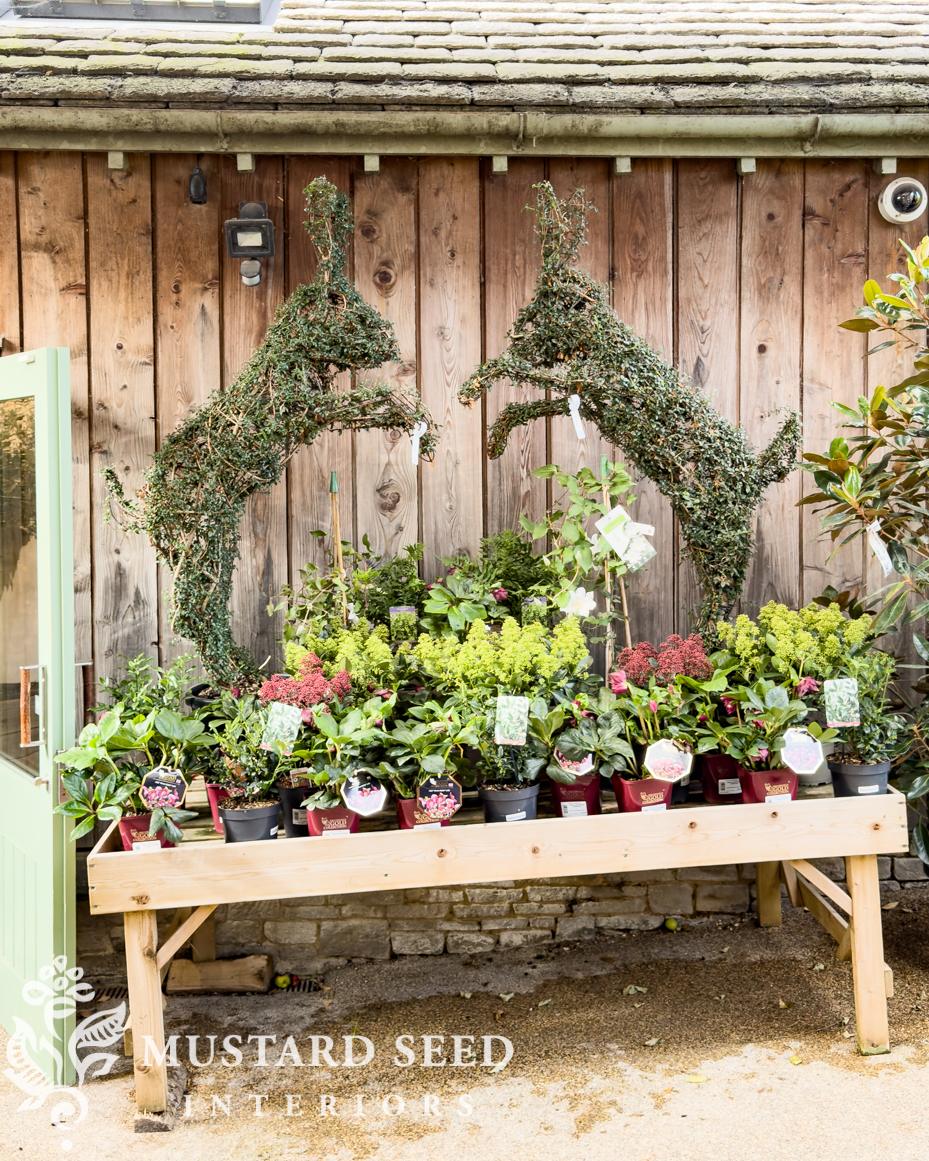
Their garden center was amazing, and I enjoyed looking at all of the plants and topiary. While some prices were astronomical, some were very reasonable. I flipped over the tag of an impressive rosemary topiary to find it was less than what it would have cost in the US. Sadly, a rosemary topiary would’ve been both impractical and illegal to bring home.
After milling through different shopping areas, we decided to have tea and scones at one of their eating areas. We sat in generously sized white armchairs, pulled around a square table. With a wall of windows, the environment was bright and inviting, and the comfortable chairs indicated that you could take your time. We all ordered classic buttermilk scones with raisins, clotted cream, and raspberry jam. As in the US, the calories were listed under each menu item, so we were warned that our “snack” would be over 600 calories. This prompted me to question Julia if English calories were the same as US calories. Sadly, they are, but when one has the chance to have an English scone with proper clotted cream and organic local jam, one does not fuss over things as small as calories. One enjoys the scone.
I did learn that the appropriate application of the cream and jam was a hotly debated topic among the English. Should you apply the jam first and risk a soggy scone? Or should you spread the clotted cream first?
I decided to go with the logical argument that clotted cream would provide a barrier between the jam and the scone and applied my toppings thusly…
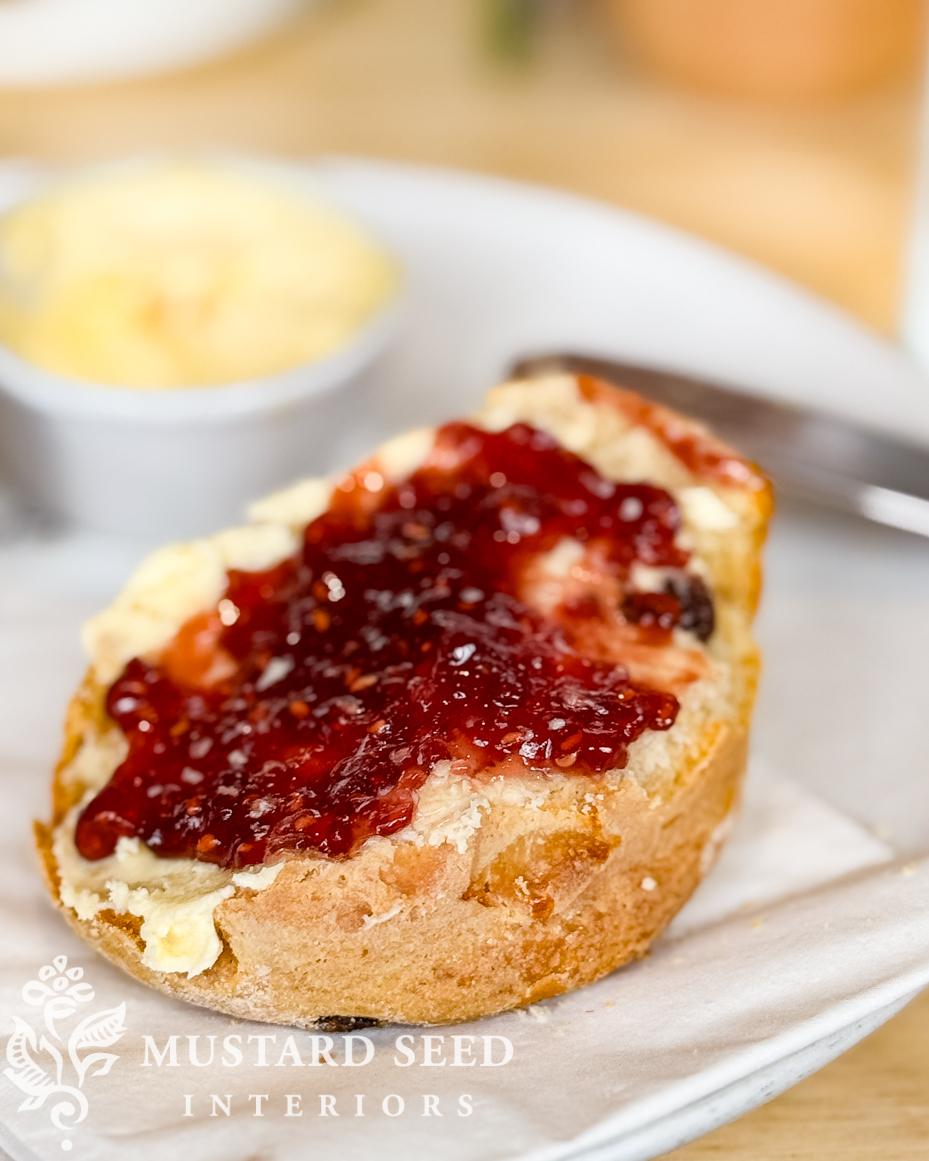
Carol, who was sitting next to me, made me immediately jealous of her cream-and-jam application. Maybe this is the Yorkshire way? I had shown my American naiveté and was far too scant with both the clotted cream and jam. It wasn’t so much about the order as it was about being liberal and consuming every single one of those 600+ calories without apology. I recified the situation and slathered on more jam and cream.
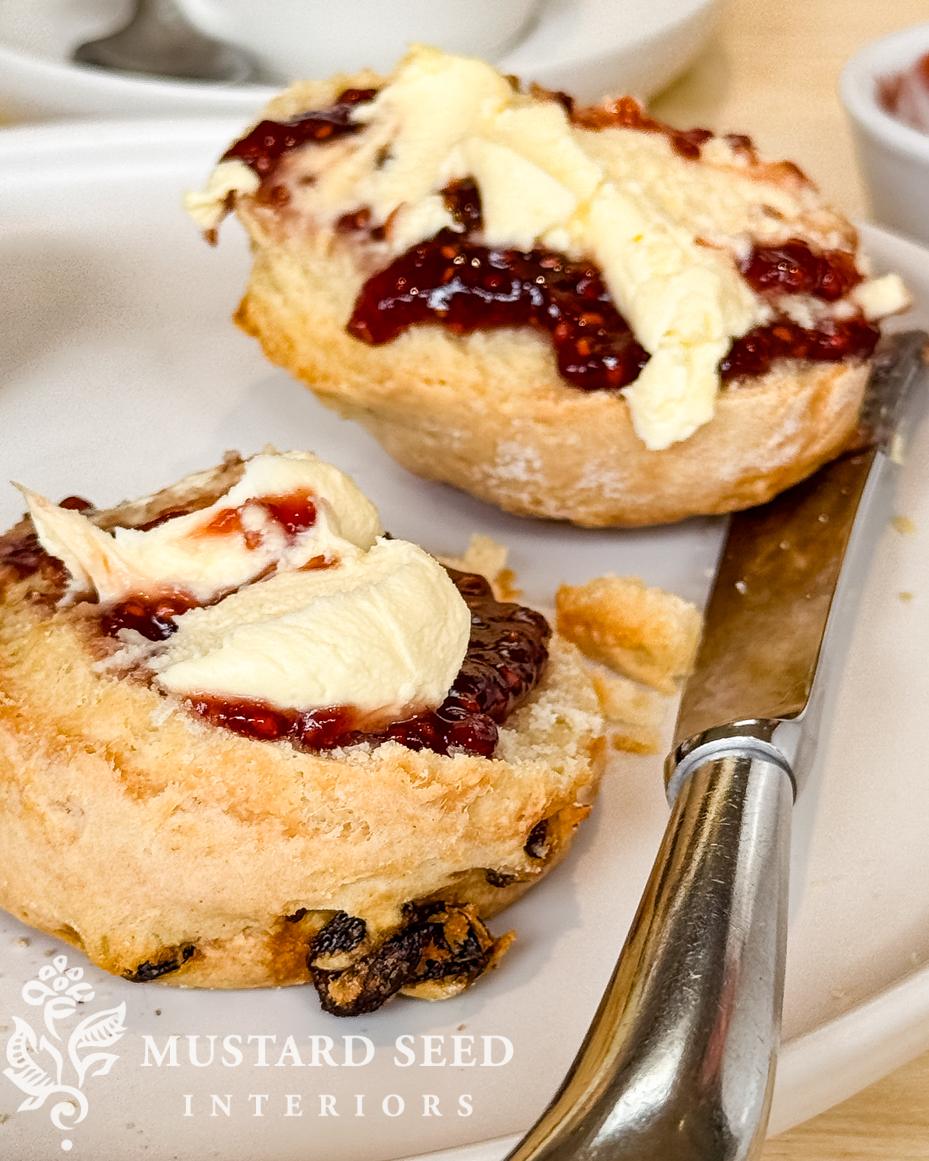
I haven’t eaten another scone with clotted cream and jam to compare this one to, but I can’t imagine one that would be better. It was heavenly in every respect. The jam was perfection—tart and tasting of fresh raspberries without being overly sweet. The scone was fluffy and light with just the right amount of tooth to the golden crust. It wasn’t crumbly or dense, but had the consistency you strive for when baking. I’d never had genuine clotted cream before, and it wasn’t what I expected.
Years ago, I had an American facsimile of English clotted cream, a mixture of butter and cream cheese. Of course, this resulted in something that tasted more like unsweetened icing. The clotted cream at Daylesford tasted more like creamy whipped butter. Clotted cream is apparently cream that has been cooked in the oven at a very low temperature for several hours. I’m definitely going to try making it at home. Anyway, the clotted cream was luxurious and velvety, the perfect complement to the lightness of the scone and the sweetness of the jam.
I can’t recommend it highly enough. I will never forget the taste of that mid-day tea.
As an aside, I managed to get through England without drinking any tea. I have never been a fan of tea or coffee, which I have learned is unfortunate for social meet-ups and traveling in countries where tea is a staple. Asking a friend to meet for a glass of water doesn’t have the same ring to it. Not drinking tea in Russia and China elicited several quizzical looks, but not drinking tea in England is almost criminal. I felt like I had to keep explaining myself as I kept ordering no tea and “a still water with lots of ice.”
Julia told us a bit about Carol, her sister-in-law, before meeting her. She is a handy woman who had, almost singlehandedly, renovated her previous historic home in the Cotswolds. She showed us pictures, and it was stunning. That home was her profession and labor of love, and she DIYed everything from designing and fitting the kitchen to chiseling concrete off a 400+-year-old stone floor to sewing the curtains. She even designed, planted, and tended a beautiful formal garden. (She once came across a live grenade while digging in said garden, which resulted, as you can imagine, in quite the scene on her street when the bomb squad showed up.) I was so impressed with Carol from the outset, but little did I know the treat I was in for.
After she and her husband moved from their beloved historic home (to a “1970s monstrosity” that’s actually quite charming, in my estimation), Carol took up metal detecting as her new hobby. She calls it a “picnic with a purpose” and shared some of the perks and pitfalls of metal detecting. Apparently, it became quite the trend as people grew restless during the pandemic and farmers became weary of metal-detecting hopefuls showing up at their doors, seeking permission to scour their land. To be successful at metal detecting, you have to be somewhat of a diplomat. It’s as much about nurturing relationships and developing a good reputation so you have access to fields and woods as it is about knowing the technical aspects of using the detector.
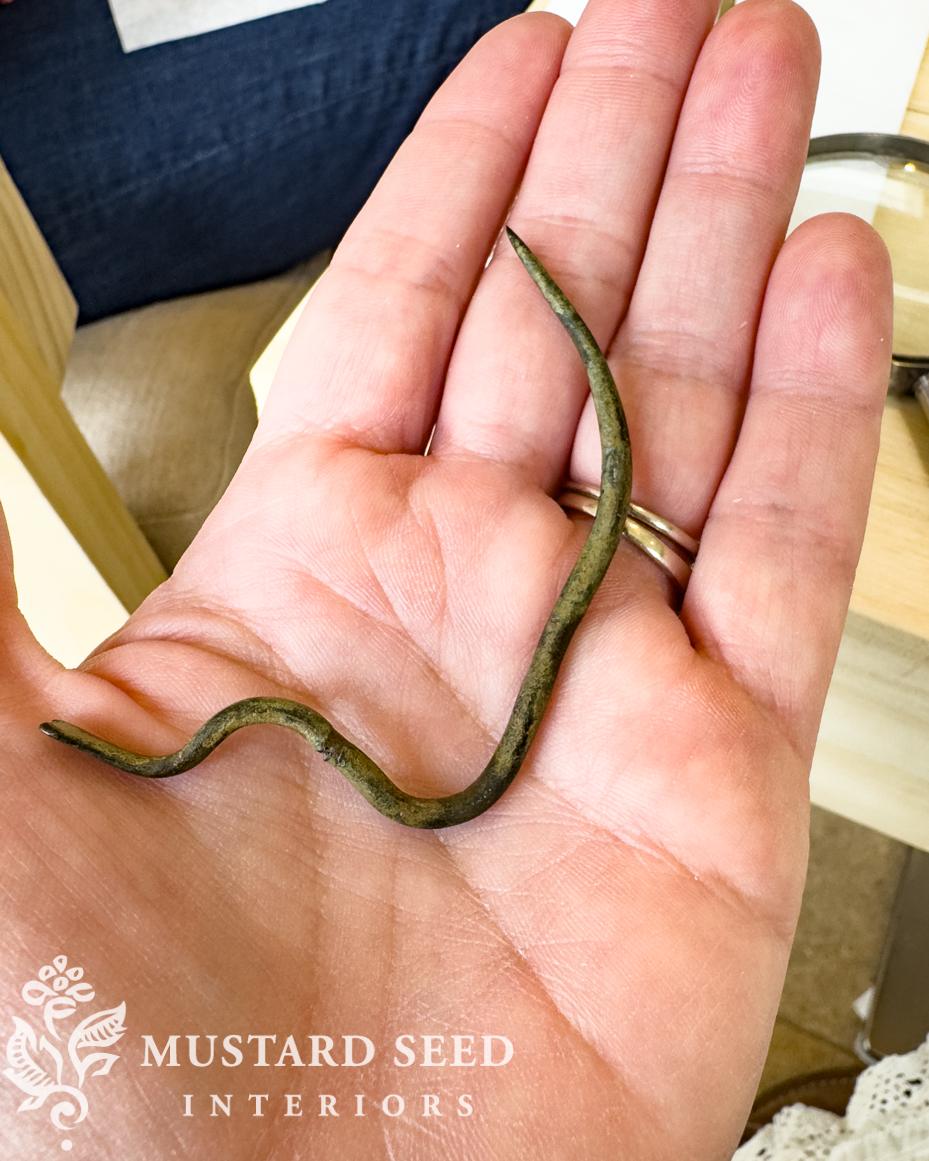
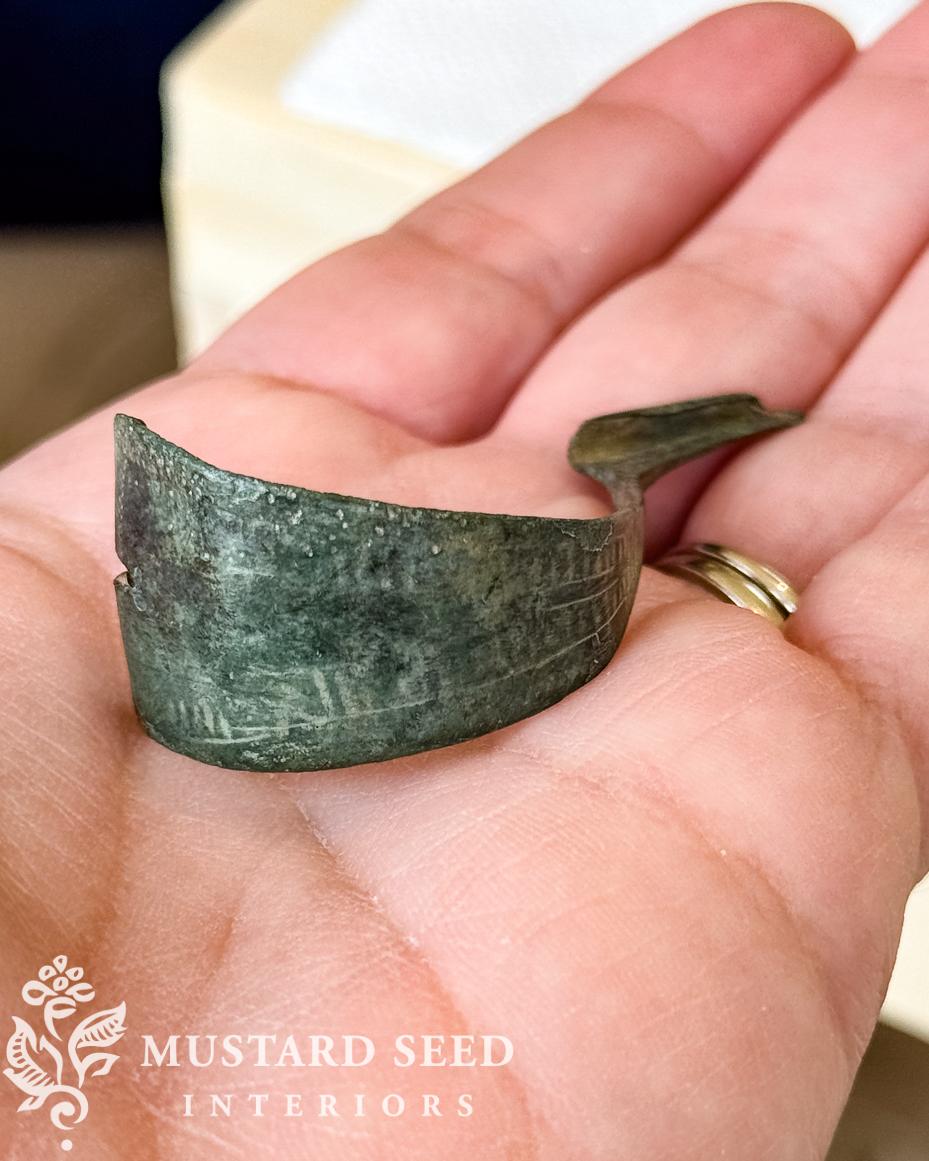
As Carol was telling us about the world of metal detecting, she pulled a small zipper pouch out of her bag. From the pouch, she unwrapped what looked like a long, bent, headless nail and placed it in my hand. It was heavier than I expected, and upon closer examination, I could see that one end was pointed and the other was flattened, with a small split. She asked me to guess what it was, and I had no idea.
She informed me that the bent piece of metal in my hand was a swan-neck pin from 800 BC. It would’ve been used to hold clothes in place, like gathered fabric over a shoulder. The explanation helped me make sense of the piece as I imagined a slender pin fitting through the small slit and a generous amount of fabric cinched and held in place, the bulk of it in the U-shaped part of the pin.
She then pulled out a more intricate piece, one of her prized finds featured in a book—an Alesia-style Roman booch from 50 BC. This was more ornate than the first pin, and you could more clearly see where the pin would fit in the channel and opposing groove. I’m imagining this brooch on a toga-like garment, or something otherwise draped and swagged.
The next find, she held cupped in her hands like a lightning bug she had just captured. “You have to hide this in your hands”, she said. She discreetly tucked the small treasure inside. What I held covered in my hands felt small, about the size of a two-by-one Lego brick. It was heavy for its size, though, and I could feel small protrusions and details.
Carol described the moment she found this piece. (And you have to do your best to hear this in a wonderful Yorkshire accent.) Just imagine: I pull this packed clod of earth out of the ground. Imagine rubbing the dirt off, not knowing what it is. She motioned rubbing dirt from a small imaginary object in her palm with her thumb. What you’re feeling is what I felt. What do you think it is?
Again, I had no idea. While I’m interested in history, I haven’t delved into Anglo-Saxon, Celtic, and Roman archaeological finds in England. Other than a coin —which this clearly wasn’t —I wasn’t even sure what someone with a metal detector in a farm field would be looking for. She permitted me to open my hand to discover that what I was holding was a small Celtic figure, likely a fertility charm. I’ve always had an active imagination, and I couldn’t help but imagine the woman who must’ve gripped tightly to this small figure, hoping it might bring her a child.

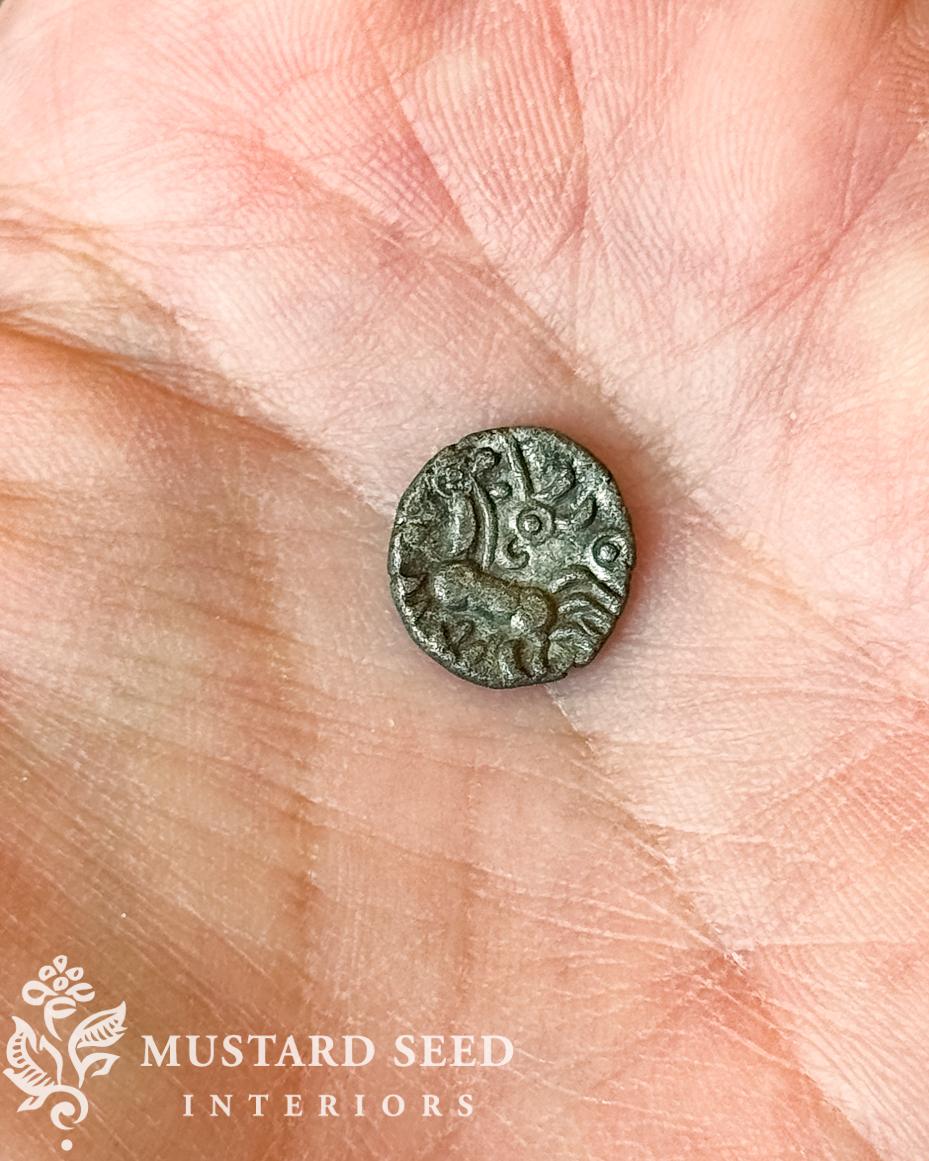
Carol released the next find from the sealed plastic case it was stored in. “You need to feel this in your hand.” She pressed a tiny coin into my palm, probably about the size of the head of a thumbtack. She told me to put the pad of my index finger on it and, when I did, I could feel that the coin was concave. This is, apparently, a hallmark of ancient Celtic coins. This particular coin sported a crude depiction of a three-tailed horse.
Throughout the course of the show-and-tell, Carol also gave me the opportunity to hold an amber bead found in a Saxon hoard, a 17th-century affection ring, and a few other charms, tokens, and coins.
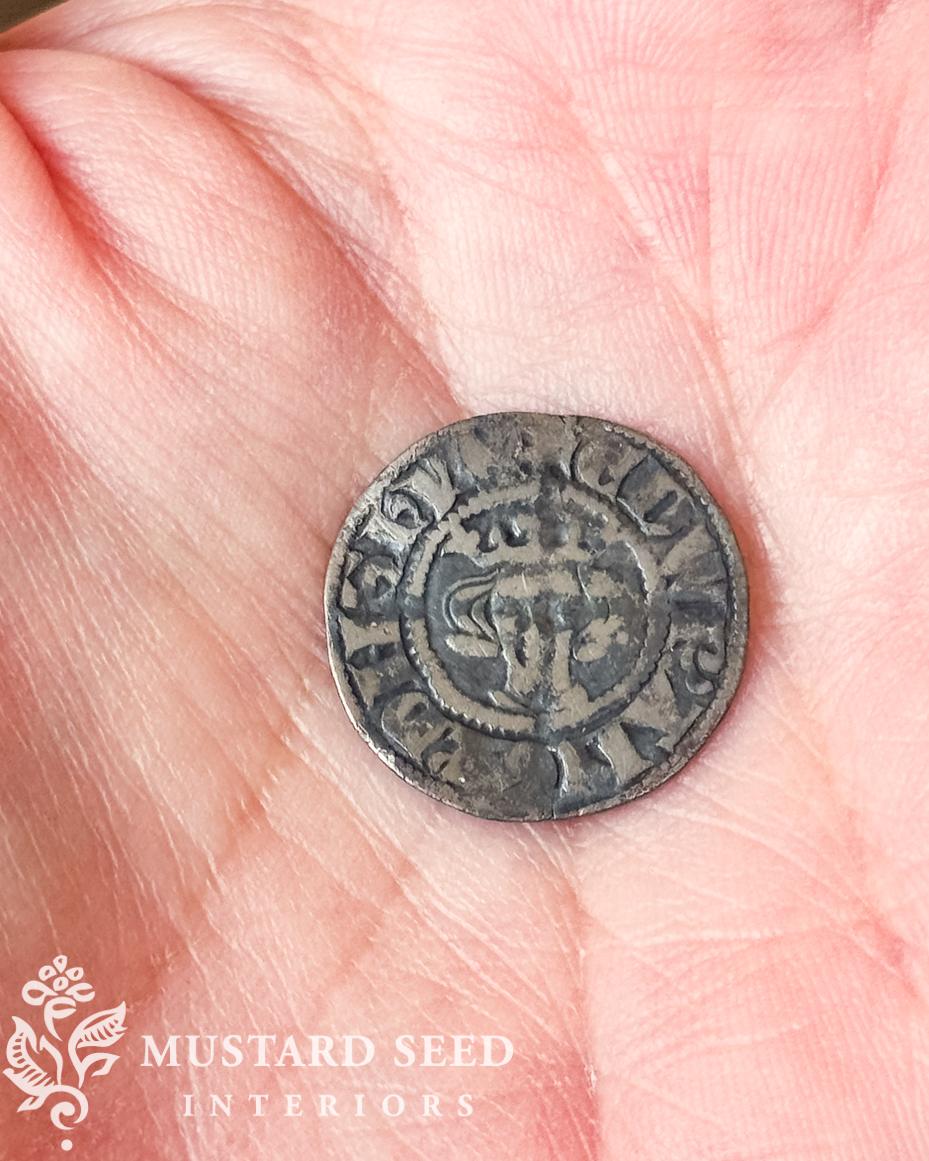
Somehow, my English heritage came up in the conversation, and I told her I’m a 22nd-great-granddaughter of Edward the Longshanks. Coincidentally, she had an Edward I coin in her bag of goodies. Can’t you see the family resemblance?
It was such an enjoyable, enriching afternoon learning about history, archaeology, and metal detecting.
Carol shared that she detects by gut and luck. She doesn’t map out a grid, but sets off to see what she happens upon. I learned from her, though, that there is some strategy involved. She’ll look over satellite images of fields to see how they change over time and what areas might be of interest to detect. They look for all sorts of things, such as changes in soil color or areas with clear man-made lines. It also isn’t a waste of time to detect the same areas repeatedly since the land is always changing. After plowing or a harvest, the new earth is turned over, and some new find might have been turned over with it. Soil is also more conductive when it’s wet, so even the weather can play a significant role in a successful metal detecting day.
As you can imagine, it is a hit-or-miss hobby. The small zipper pouch of treasures was discovered over more than a decade of consistent looking. You have to decide that it’s worth all the bottle caps, shell casings, and screws to have a chance at finding an 800-year-old pin.
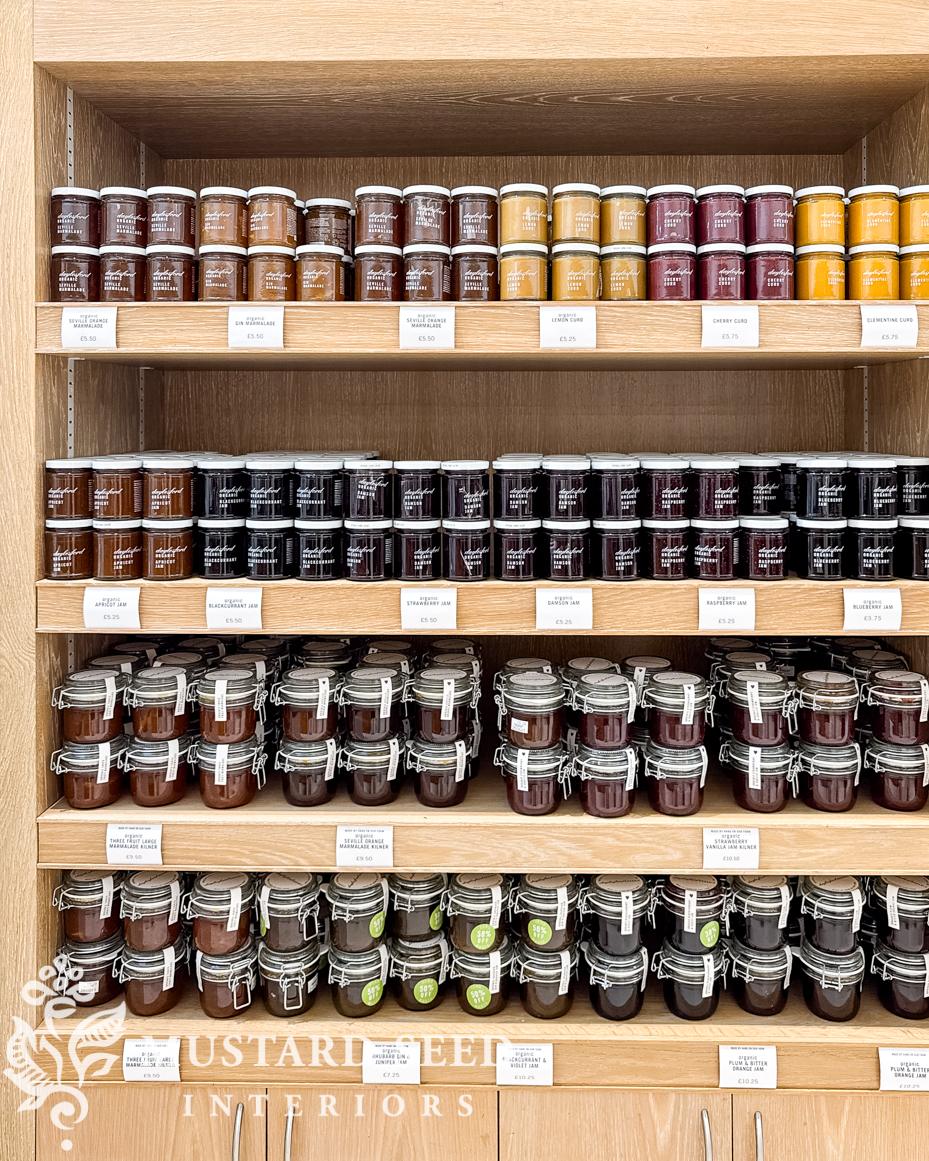
Once we were done with the conversation, tea, and scones, I bought a few things from Daylesford before leaving. I splurged on THIS fabulous tote bag and a couple of jars of organic jam to bring home to Jeff and the boys.
From there, we did some more driving around and picture-taking, and met later in the evening at The Village Pub in Barnsley. The pub is owned by The Pig, which is a chain of restaurants and hotels in England that I shared more about in THIS POST. Our dinner at the Noel Arms in Chipping Campden the night before would be hard to beat, but The Village Pub managed to meet expectations. It’s another pub I would highly recommend for authentic English food.
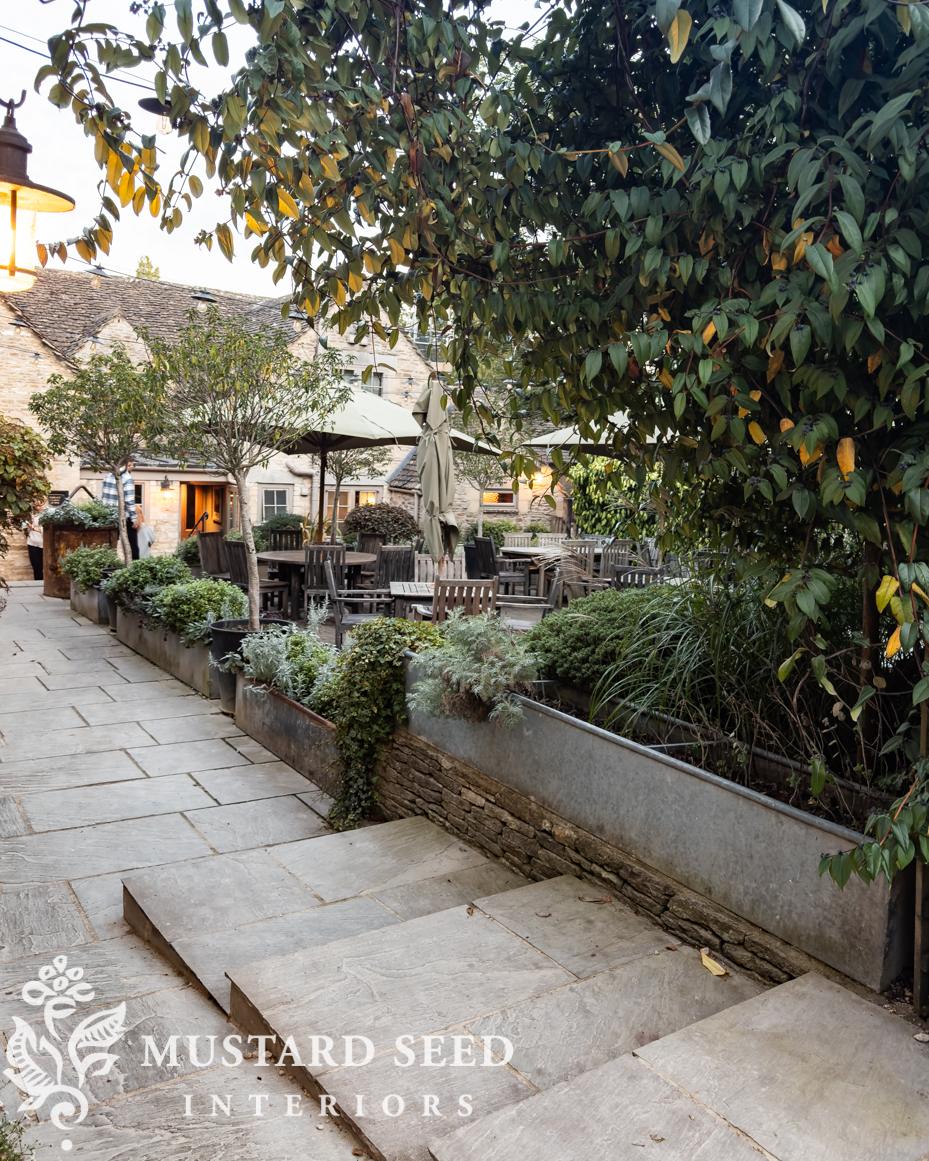
It’s also beautiful, with a quaint, historic dining room…

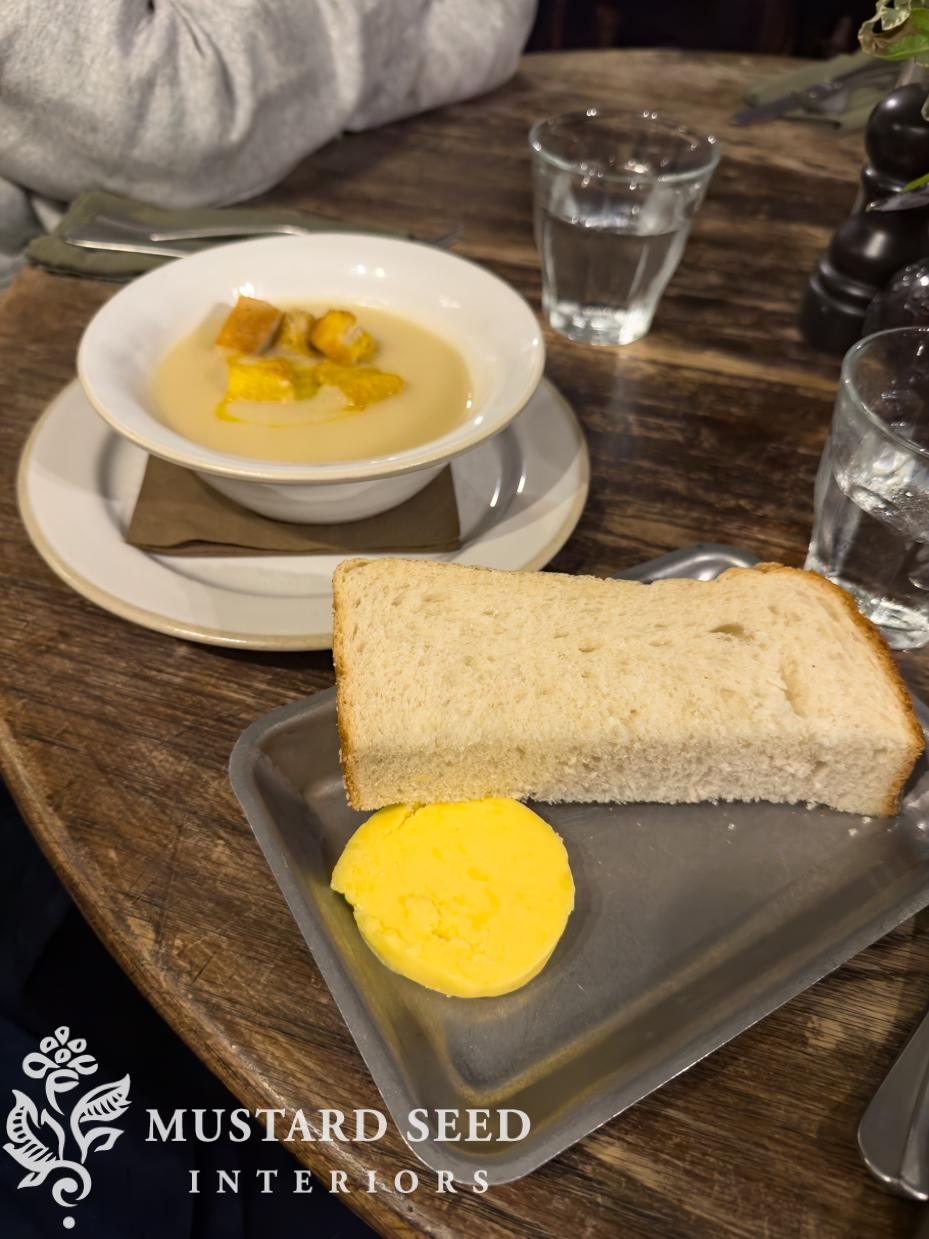
I was still a little full from the scones, so I ordered apple and parsnip soup with a chunk of bread and butter.
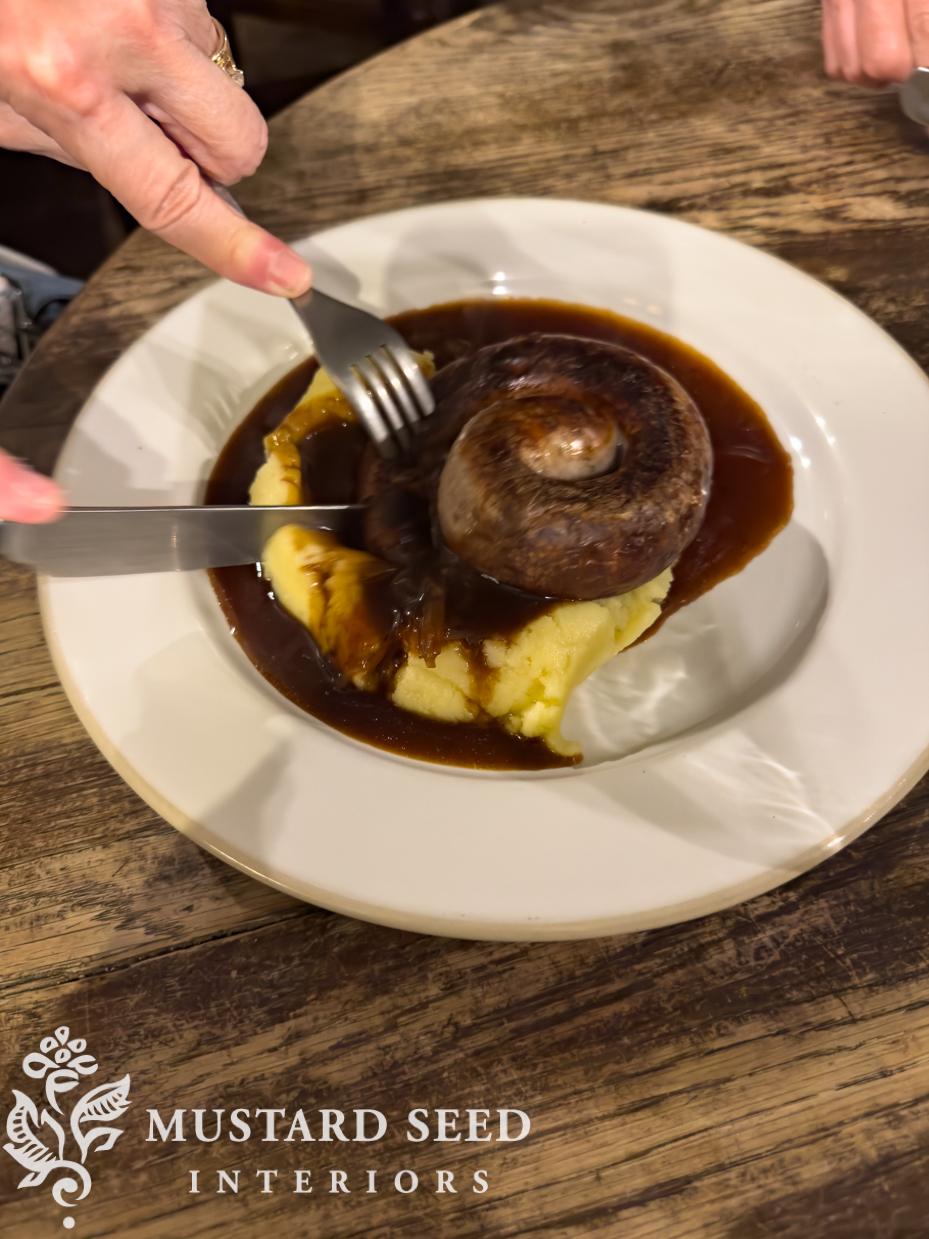
Mom went full-English and ordered bangers and mash. I wish the picture I took of her dinner hadn’t been blurry, but it was just what you’d hope for from bangers and mash. I’m not a big meat-eater, so I would never order something that featured sausage, but I am always up for trying local fare when I travel. Food is such a big part of a culture that I feel like trying local food enriches travel. How can we really experience England if we’re eating at American chain restaurants?
So, I tried the bangers and mash, and it truly was delicious. The gravy was rich and flavorful, the sausage wasn’t overly spiced and tasted like high-quality meat, and the potatoes were silky and buttery. I was enamored with the gravy and kept dipping my bread into it.
Travel is about seeing places, yes, but my favorite part of travel is meeting people. It’s discovering kinships, having long conversations, listening with openness, and delighting in the foreign. Traveling should be a little uncomfortable, eye-opening, and overwhelming. If it all feels too safe, comfortable, and familiar, why not just stay at home?
This wasn’t about visiting as many villages as possible. It was about learning, following curiosity, filling my creative well, and enjoying a country with a shared language but a different culture. We talked about the day with our port and chocolate on the sofa in front of the hearth in our thatched cottage. I hadn’t had my fill of the English countryside. Instead of spending our last day in London, we opted to stay on the outskirts and visit the home of a beloved author…
You can read my next post in this travelogue series HERE.

Arrival & Burford | “gateway to the Cotswolds”
Cirencester, Seasalt Cornwall, and Bourton-on-the-Water
The Thatched Cottage in Chipping Campden
Hidcote Manor | National Trust Home & Garden
Plein Air Painting at Hidcote Manor











8 Responses
Another wonderful day. There is something about getting out of your comfort zone – traveling solo, eating by yourself, trying something different. You learn more about yourself, what you’re capable of doing, and discovering there is a whole world out there waiting to be discovered.
I am already deciding which paintings I am going to try to nab at your next art sale, based on your collection of landscape photos from your England trip! I can’t wait to see what you do!
Marian, you should read Raising Hare by Chloe Dalton. I thought of it as it takes place in the English countryside, it is about hares (similar to the rabbits you paint and photograph), and it is a wonderful book that I think you would love.
I was actually a little turned off by Daylesford farm – it was so pretentious and overpriced – but glad you liked it. If you want to watch a fun show about metal detecting, check out “The Detectorists.” It’s filled with quirky but loveable characters. You have to get used to the slow pace, but stick with it! One of my all time favorite shows. I’m not sure what streaming service it is on now – it moves around – but possibly Acorn.
Yeah, I think it’s fair to say that Daylesford is pretentious and some items are definitely overpriced! I still loved it. I thought it was so beautifully done.
Good choice to avoid London.
I’m deeply jealous of your scones, jam and cream.
And the tote you splurged on is just perfect!
Do you envision a life abroad when the boys fly the nest?
They were wonderful! If there ever came the opportunity, I would definitely be interested in living overseas again. 🙂 I don’t see it happening in the near future, but one never knows.
Oh Marion this is so fun seeing and hearing of your adventures in the Cotswolds as we were literally just there and did almost exactly the same trip- minus Julia! When I saw the picture in your blog the other day I did a double take because i knew exactly where you were since I have the same picture of Dovers Hill! I am also a painter although I do not have even close to your talents but am enjoying painting. I felt the same way about Daylesford Farms- lots of eye candy and quite beautiful but almost too much! I also took a million pictures but I would love to paint some of your excellent photos which I can assure you are much better than mine! It was all an absolute dream trip for us!
Hi Marian!
If you enjoyed Carol’s finds you might also enjoy the show The Detectorists. It’s set in England and the main two characters have a hobby of metal detecting for historic finds. The show is about them as people, but the metal detecting is a huge part of it and very interesting. Also the theme song is very nice. My sister actually walked down the aisle to it. 🙂